

Schema Markup for AI Crawlers: Why It Matters in 2026
Sites with complete schema markup are 2.7x more likely to get cited in Perplexity, and 3.1x more likely to appear in Google AI Overviews, according to a 2025 Cludo analysis of 12,000 European websites. That gap is exactly why structured data for LLMs has become a core part of AI visibility strategy in 2026. In this post, you’ll learn what structured data for LLMs actually does, which schema types matter most for AI crawler optimization, and how to implement schema for AI search without wasting time on markup that doesn’t move the needle.
What Is Structured Data for LLMs?
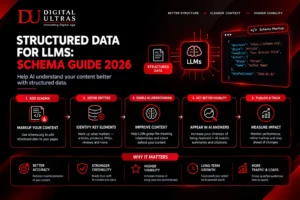
What is structured data for LLMs? Structured data for LLMs is machine-readable markup, usually Schema.org in JSON-LD format, that explicitly labels entities, facts, and relationships on a page so AI systems can extract and verify information without guessing.
Google’s crawler uses schema mainly to trigger rich snippets. LLMs use it differently to resolve identity, confirm facts, and decide whether your content is trustworthy enough to cite. That distinction is why structured data for LLMs deserves its own strategy, separate from classic SEO schema work.
Does Structured Data for LLMs Actually Drive Citations?
Yes, but it’s a clarity layer, not a guaranteed trigger. Schema helps AI systems trust and extract your content faster, which increases citation odds.
| Source | Finding |
| BrightEdge (2026) | 44% increase in AI citations after adding schema + FAQ blocks |
| Cludo (2025, 12,000 sites) | 2.7x Perplexity citation odds, 3.1x for Google AI Overviews |
| Stackmatix (2026) | 2.5x higher citation chance; up to 40% more AI Overview appearances |
| OptimizeGEO (2026) | 1.8x more citations from stacking FAQPage, Article, and HowTo schema |
Worth noting: Google’s own documentation says structured data isn’t strictly required for its generative AI features. Treat schema as infrastructure that removes ambiguity, not a magic switch; weak content with perfect markup still won’t get cited.
Schema for AI Search: The Types That Matter Most
Schema for AI search works best when you prioritize types that structure your actual answers, not just your site’s navigation.
How to Implement AI Crawler Optimization: A Step-by-Step Guide
- Choose JSON-LD. Every major AI engine parses it more reliably than Microdata or RDFa, since it’s cleanly separated from your HTML.
- Start with FAQPage schema. It produces the highest citation lift because each answer is effectively pre-formatted for AI extraction.
- Add Article and Organization schema. These resolve authorship and identity, both key trust signals for AI crawler optimization.
- Render schema server-side. If JSON-LD only loads client-side, AI crawlers may never see it; use SSR or static generation.
- Keep data accurate and current. Outdated prices, hours, or descriptions in your schema can quietly damage LLM trust over time.
A Mini Case Study: Schema Fix, Real Citation Lift
A Gurugram-based B2B SaaS client had strong content but almost no AI citations. An audit showed their JSON-LD was client-side rendered and invisible to most crawlers. We moved it server-side, added FAQPage schema to their top ten pages, and layered in Organization schema for identity clarity. Within two months, they went from zero to six tracked citations across Perplexity and Google AI Overviews proof that structured data for LLMs works best paired with content that’s already worth citing.
Common Mistakes to Avoid
- Adding schema to thin or generic content, expecting markup alone to earn citations.
- Using client-side-only rendering, which hides your structured data for LLMs from crawlers entirely.
- Stacking every schema type available instead of prioritizing FAQPage, Article, and Organization first.
- Letting schema data go stale while the visible page content gets updated.
If your team doesn’t have the technical bandwidth to handle this in-house, a full-service digital marketing company in India can usually fold structured data implementation into a broader AI visibility and content strategy without adding a separate vendor to manage.
| Schema Type | What It Does for AI Crawlers |
| FAQPage | Structures content as standalone Q&A pairs — the highest citation lift of any type |
| Article | Confirms authorship, publish date, and topic for credibility checks |
| HowTo | Breaks down step-based content into extractable, ordered instructions |
| Organization | Resolves who you are — name, address, sector — reducing identity ambiguity |
| BreadcrumbList | Reinforces site structure; supports understanding but doesn’t drive citations alone. |
Frequently Asked Questions
Q: What is structured data for LLMs used for?
A: It’s markup that labels facts, entities, and relationships on a page so AI systems like ChatGPT and Perplexity can extract and verify information reliably, increasing the odds your content gets cited accurately in AI-generated answers.
Q: Which schema type helps AI crawler optimization the most?
A: FAQPage schema consistently produces the highest citation lift, since it structures content as standalone Q&A pairs that AI models can extract and cite directly without needing to reformulate your writing.
Q: Does schema for AI search guarantee citations?
A: No. Schema improves clarity and trust signals, but weak or thin content won’t get cited just because it’s marked up correctly. Structured data works best combined with genuinely useful, well-written content.
Q: Is JSON-LD better than Microdata for structured data for LLMs?
A: Yes. JSON-LD is cleanly separated from your HTML, making it easier for AI crawlers to parse without interference. It’s the format every major AI engine, including ChatGPT and Perplexity, relies on most reliably.
Want to stay ahead of AI-driven marketing? Book a free consultation with DigitalUltras.
