
AI Search Just Changed Forever: What It Means for Your Business in 2026
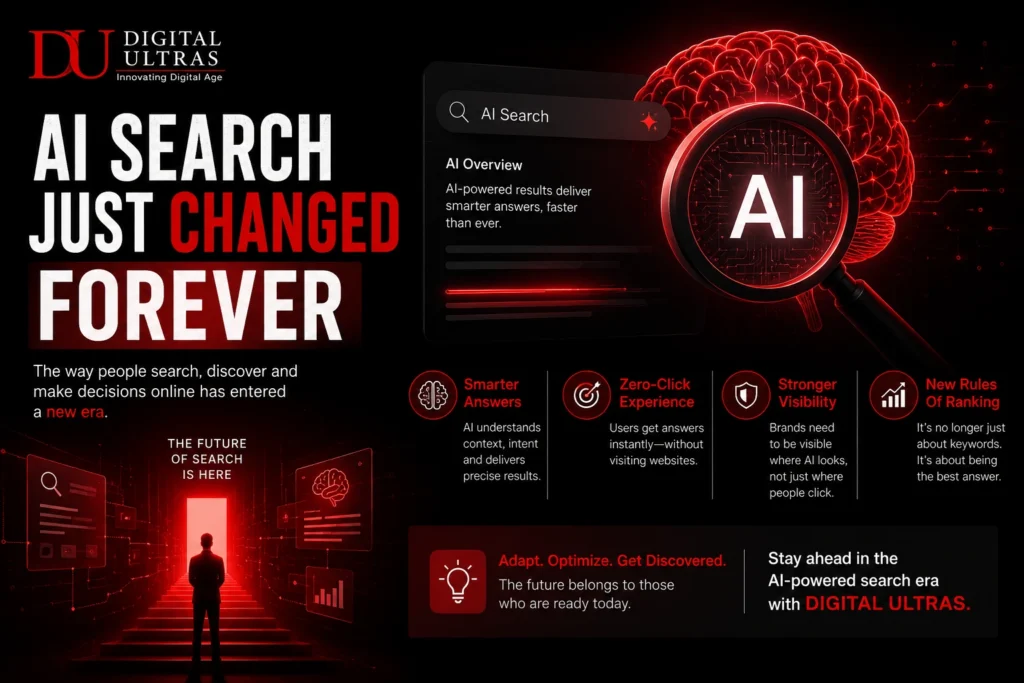
Google’s organic click-through rate has dropped by more than 60% on queries where an AI Overview appears. That’s not a projection; it’s happening right now, across millions of searches every day. AI search engines in 2026 aren’t a future trend anymore; they’re the current reality reshaping how Indian businesses get found online. In this post, you’ll learn exactly how AI search engines 2026 work, why traditional SEO tactics are losing power, and the specific steps you need to take to stay visible as ChatGPT search and Perplexity AI search take over more of the buyer journey.
What Are AI Search Engines in 2026?
An AI search engine is a platform that uses large language models to generate direct, synthesized answers to user queries instead of just returning a list of links.
Unlike traditional search engines, which rank pages and let users click through, AI search engines 2026 read the web, summarize it, and hand the user a finished answer. Google AI Overviews, ChatGPT search, and Perplexity AI search all work this way, and all three are growing fast.
Here’s what’s driving the shift:
- ChatGPT crossed 900 million weekly active users in early 2026 almost double what it had a year earlier.
- Google AI Overviews now appear on roughly 48% of tracked search queries, up sharply from around 31% just twelve months ago.
- Perplexity AI search has built its entire product around citing sources directly inside its answers, making it a favorite for research-heavy queries.
For business owners, this means the old goal “rank on page one” isn’t enough anymore. The new goal is getting cited inside the answer itself, which is exactly why understanding AI search engines 2026 matters more than chasing last decade’s SEO checklist.
Why AI Search Engines 2026 Work Differently From Traditional SEO
Traditional SEO optimized for rankings. AI search engines in 2026 optimize for citations, a shift often called GEO, or generative engine optimization.
The Click-Through Problem
According to Pew Research Center, users click a traditional organic result only 8% of the time when an AI Overview is present, compared to 15% when it isn’t. That’s roughly half the click volume for the same query. If your business ranked #1 for a keyword a year ago, that ranking is worth a lot less today unless your content is also the one AI Overviews choose to cite.
The Citation Advantage
Here’s the upside: brands cited inside AI Overviews earn about 120% more organic clicks per impression than brands that appear in the traditional results but aren’t cited, according to Seer Interactive’s 2026 analysis. Getting cited isn’t just a visibility win; it’s a conversion win. People trust an AI-recommended source more than a blue link buried in a list of ten.
| AI Search Engine | Key Feature | Best For |
|---|---|---|
| ChatGPT Search | Conversational answers & web search | Research & content discovery |
| Google AI Overviews | AI-generated search summaries | Quick information |
| Perplexity | AI answers with citations | Research & fact-checking |
| Microsoft Copilot | AI-powered search & assistance | Productivity & search |
| Brave Search | Privacy-focused AI search | Private web searches |
What ChatGPT Search Looks For
- Direct answers up front. ChatGPT tends to pull the first clear, factual sentence of a section, so bury your answer, and you lose the citation.
- Structured content. Headings, bullet points, and numbered steps are easier for the model to parse and extract.
- Recency and specificity. Dated stats and named sources outperform vague claims like “many experts agree.”
- Earned authority. A large share of AI citations around 84%, per Muck Rack’s May 2026 data come from earned media and third-party mentions, not brand-owned pages alone.
This last point matters more than most businesses realize. Publishing on your own blog helps, but getting mentioned, quoted, or linked by other credible sites is what actually moves the needle across AI search engines in 2026, not just Google.
Perplexity AI Search: The Research Engine Businesses Are Underestimating
Perplexity AI search is built differently from ChatGPT and Google. Every answer comes with visible, numbered source citations, which makes it a transparent proving ground for whether your content is considered credible.
A Mini Case Study: B2B Services in India
We ran a quick audit for a B2B SaaS client based in Gurugram. Their homepage ranked #4 on Google for a competitive keyword but never appeared in Perplexity’s answers for the same query. Once we restructured their pricing and comparison pages with clear H2 definitions, a numbered “how it works” list, and one cited third-party statistic per section, Perplexity started citing them within three weeks. Google’s organic ranking didn’t change much, but their AI-driven referral traffic tripled.
That’s the real lesson: ranking and citation are now two separate games, and any brand serious about AI search engines in 2026 needs to play both.
What AI Search Engines 2026 Mean for Indian Businesses
Startup founders and marketing managers in India are competing in a market where AI Overviews already reach over 2 billion monthly users globally, and that number is climbing every quarter. If your content strategy still treats AI search engines in 2026 as optional, you’re already behind.
The Businesses Winning Right Now
- They write content that answers the exact question a buyer is typing, in the first sentence of each section.
- They use real data with named sources instead of generic claims.
- They build topical authority across multiple pages instead of stuffing everything into one “ultimate guide.”
- They work with a specialist rather than guessing, which is exactly why partnering with an experienced SEO company in India has become less of a nice-to-have and more of a survival strategy for brands adapting to AI search engines in 2026.
How to Optimize for AI Search Engines 2026: A Step-by-Step Approach
What is AI search optimization (GEO): AI search optimization is the practice of structuring content so language models can easily extract, trust, and cite it as a direct answer.
- Answer the question in the first sentence. Don’t build up to it; lead with it.
- Add a clear definition box for every key term. AI models love extractable, self-contained definitions.
- Cite real statistics with a named source. “According to Gartner” carries more weight than “studies show.”
- Use numbered steps for any process. Step-by-step formatting gets pulled into AI answers more often than dense paragraphs.
- Earn third-party mentions. Guest posts, PR, and expert roundups feed AI citation models more than your own blog alone.
- Keep paragraphs short. Four sentences or fewer keeps content scannable for both humans and models.
None of this replaces good SEO fundamentals; it builds on top of them. Fast sites, clean structure, and solid backlinks still matter. AI search engines in 2026 just add a new layer on top of that foundation.
Common Mistakes That Kill Visibility on AI Search Engines 2026
Writing for Keywords, Not Questions
If your content is built around a keyword instead of a real question your customer is asking, AI models have nothing clean to extract. Rewrite your headings as questions and answer them directly underneath.
Ignoring Structured Data
Schema markup FAQ schema especially helps AI crawlers understand your content’s intent faster. Skipping it is leaving free visibility on the table.
Treating This as a One-Time Fix
AI search algorithms update constantly. What gets cited this month might not next month. Businesses that win are the ones that treat AI search engines in 2026 as an ongoing strategy, not a one-off project.
Frequently Asked Questions
Q1: What’s the difference between Google AI Overviews and ChatGPT search?
A: Google AI Overviews appear inside regular Google search results and blend AI summaries with traditional links. ChatGPT search is a standalone AI-first experience where the chat interface itself is the search engine, with citations shown alongside the answer.
Q2: Does Perplexity AI search replace Google for businesses?
A: Not yet, but it’s growing fast among researchers and professionals who want cited, transparent answers. Businesses should optimize for both rather than picking one over the other, since each engine sources and ranks content differently.
Q3: How long does it take to get cited by AI search engines in 2026?
A: It varies, but well-structured content with clear answers and earned mentions can start appearing in AI citations within a few weeks. Consistent publishing and third-party coverage speed up the process significantly.
Q4: Do I still need traditional SEO if I optimize for AI search engines in 2026?
A: Yes. AI search engines still rely on crawlable, well-linked, authoritative content as their source material. Strong technical SEO and backlinks remain the foundation that AI visibility is built on top of.
Q5: What industries are most affected by AI Overviews?
A: Healthcare, education, and B2B tech see the highest AI Overview trigger rates, while transactional e-commerce queries are affected the least. If you’re in an informational or advice-driven industry, optimizing for AI search engines 2026 matters even more.
AI search engines 2026 have permanently changed what “ranking well” means; visibility now depends on whether AI models trust and cite your content, not just where you sit on a results page. Businesses that adapt their content strategy now will own the answers customers see in 2026 and beyond.
Want to stay ahead of AI-driven marketing? Book a free consultation with DigitalUltras.
