
How to Rank in Google AI Overviews Before Your Competitor Does
Only 11% of websites cited in Google AI Overviews are the same pages that rank #1 organically for the same query, according to a 2025 BrightEdge analysis of 10,000 AI Overview citations. That single stat reframes everything. You don’t have to dominate traditional SEO to win AI visibility, but you do need a completely different content strategy. This post gives you the exact playbook to rank in Google AI Overviews ahead of your competitors.
What Does It Mean to Rank in Google AI Overviews?
Here’s the critical distinction: ranking in AI Overviews is not the same as ranking #1 organically. Google’s AI selects sources based on content structure, authority signals, and answer clarity, not just keyword relevance and backlinks. A page sitting at position six can get cited in an AI Overview, while the page at position one gets zero mentions.
According to Semrush’s 2025 AI Overview Citation Study, pages with FAQ schema markup are 2.7x more likely to appear in AI Overview citations than pages without it. That’s not a minor SEO tweak; it’s a structural advantage you can implement today.
Why Your Current SEO Strategy Won’t Get You Into AIOverviews
Traditional SEO optimises for Google’s ranking algorithm. AI Overviews are selected by a different system with different priorities, and most websites aren’t built for it.
Standard SEO signals like domain authority, keyword density, and internal linking still matter as a foundation. But Google’s AI system is specifically looking for content that is easy to extract, clearly structured, and verifiably accurate. Most SEO-optimised content is written to keep users on the page with long introductions, context-building paragraphs, and narrative flow. AI systems don’t reward that structure. They reward directness.
The 8 Signals Google Uses to Rank in AI Overviews
Google’s AI selects sources for AI Overviews based on a combination of technical, structural, and authority signals, understanding that each one gives you a clear optimisation target.
1. Direct-Answer H2 and H3 Openings
The single most impactful structural change you can make is rewriting your section headings and their opening sentences to answer the query immediately. If your H2 is “Understanding Page Speed” and the first sentence is “Page speed has been a ranking factor since 2010,” you’ve told Google almost nothing extractable. If your H2 is “What Is Page Speed and Why Does It Affect Rankings?” and your first sentence is “Page speed measures how fast your web page loads for a user, and it directly affects both rankings and conversion rates,” Google has a clean, extractable answer it can cite instantly.
2. Definition Boxes for Key Terms
Definition boxes, a bolded term label followed by a single, precise sentence, are one of the highest-confidence citation signals for Google’s AI. They mirror the format AI systems use in their own answers, making extraction trivial. Every key term in your content should have one.
3. Named Statistical Citations
Google’s AI system treats verifiable, attributed data as a credibility signal. Content that says “studies show engagement increases with video” provides no citation value. Content that says “According to HubSpot’s 2025 State of Marketing Report, video content generates 66% more qualified leads than static formats” gives Google something factually grounded to extract and attribute to video content. Every major section of your content should contain at least one named statistic.
4. FAQ Schema Markup
Implementing the FAQ schema on your key pages tells Google’s system that you’ve structured your content to answer specific questions, exactly what AI Overviews are designed to do. Pages with FAQ schema get preferential consideration in the AI citation selection process, and the implementation takes under an hour in most CMS environments.
5. Topical Authority Depth
Google’s AI strongly favours sources that demonstrate deep expertise across a topic, not just a single well-optimised article. If you have one strong piece on “AI marketing tools” and nothing else in that content cluster, you’re a single data point. If you have a pillar page, six supporting articles, a glossary, and two case studies on the same topic, you’re an authority. The AI system treats your site as a trusted source category, not just an individual page.
6. E-E-A-T Signals
Experience, Expertise, Authoritativeness, and Trustworthiness remain core selection criteria for AI Overview citations. Author credentials, first-person expert commentary, verifiable claims, and transparent sourcing all contribute. AI systems are trained to prefer sources that demonstrate they have genuine expertise, not just content that reads as it does.
7. Content Freshness
AI Overviews for fast-moving topics, technology, marketing, finance, and regulatory strongly prefer recently updated content. A blog post from 2022 with no updates is invisible to an AI Overview query asking about 2026 conditions. Build a quarterly content refresh cadence into your editorial calendar, particularly for your highest-traffic pillar pages.
8. Mobile Performance and Core Web Vitals
Google’s AI selection system inherits the technical signals from its core ranking infrastructure. Pages that load slowly, fail Core Web Vitals, or deliver a poor mobile experience are deprioritised in both organic rankings and AI Overview citations. Technical SEO health is the floor you can’t win AI visibility from a technically broken page.
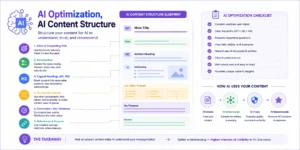
AIO Optimization: How to Structure Content That Gets Cited
AIO optimization is the discipline of structuring content specifically to be selected and cited by Google’s AI Overview system, going beyond traditional on-page SEO.
The practice of formatting, structuring, and positioning web content to meet the specific extraction and citation criteria used by Google’s AI Overview system, including direct-answer openings, definition boxes, schema markup, and named statistical attribution.
Here’s the content structure template that consistently performs in AI Overview citation audits
- H2 heading: framed as a question or a “what/how/why” statement, the user would actually search.
- Opening sentence: direct, declarative answer to the heading — no preamble
- Definition box: bolded term + one-sentence definition for any key concept in the section
- Supporting paragraph: 2–3 sentences of context, evidence, or elaboration
- Named statistic: one attributed data point from a credible source
- Practical implication: one sentence connecting the information to what the reader should do with it
Step-by-Step Action Plan to Rank in Google AI Overviews
Here’s a prioritised, practical roadmap to rank in Google AI Overviews built for Indian business owners and marketing managers who need results, not theory.
- Run an AI Overview visibility audit. Search your 20 most important keywords in Google with AI Overviews enabled. Record which queries trigger an AI Overview, which sources are cited, and whether your domain appears. This is your baseline; you can’t close a gap you haven’t measured.
- Identify your top 10 pages by organic impressions . These are the pages with the highest potential for AI Overview impact. Pull them from Google Search Console and rank them by impression volume, not just clicks.
- Audit each H2 section for direct-answer compliance. Read the opening sentence of every H2 section on your top pages. If it doesn’t directly answer the heading’s implied question within the first two sentences, rewrite it. This single change has the highest AIO citation impact of any optimisation action.
- Add definition boxes for every key term. Identify the three to five most important concepts on each page and format them as: [Bolded term label]: [Single precise definition sentence]. These are your highest-value citation extraction points.
- Replace vague source references with named attributions.
Search each page for phrases like “research shows,” “experts say,” or “studies suggest.” Replace every instance with a specific, named statistic from a credible source. If you don’t have one, find one. NASSCOM, Gartner, McKinsey, Statista, or your industry association are your first stops.
Executing this plan across a content library of 50+ pages requires both content strategy expertise and technical SEO capability working in tandem. As an SEO company in India that builds AIO optimization into every client engagement, DigitalUltras has seen firsthand how businesses that move on this now lock in citation positions that are genuinely hard for competitors to displace once established.
Frequently Asked Questions
Q: How do I rank in Google AI Overviews for my business?
A: To rank in Google AI Overviews, structure your content with direct-answer H2 openings, add definition boxes for key terms, embed named statistics from credible sources, and implement FAQ schema markup. These structural changes make your content extractable by Google’s AI system regardless of where you rank organically for the same query.
Q: Do I need to rank #1 on Google to appear in AI Overviews?
A: No, and this is the most important shift to understand. Google’s AI Overview system selects citations based on content structure, authority signals, and answer clarity, not organic position. Pages ranking at positions four to eight are regularly cited in the AI Overview, while the #1 organic result gets no mention. Structure matters more than rank for AIO visibility.
Q: What is AIO optimization, and how is it different from traditional SEO?
A: AIO optimization structures content specifically for Google’s AI Overview citation criteria,indirect-answer sections, definition boxes, FAQ schema, and named attribution. Traditional SEO optimises for keyword relevance and link authority in organic rankings. Both matter, but AIO optimization targets a separate selection system that determines AI visibility independent of standard ranking signals.
Q: How long does it take to start appearing in Google AI Overviews?
A: Most websites that implement AIO optimization changes on established pages with existing authority start seeing AI Overview citations within 30 to 60 days. Pages with strong domain authority and existing topical depth tend to see citations faster. New sites with limited authority should build topical clusters and technical signals for 3 to 4 months before expecting consistent AI Overview appearances.
Q: Does the FAQ schema really help with AI Overview citations?
A: Yes, significantly. Semrush’s 2025 data shows pages with FAQ schema are 2.7x more likely to appear in AI Overview citations. The FAQ schema tells Google’s system your content is structured to answer specific questions, which maps directly to how AI Overviews function. It’s the fastest single technical change you can make for AIO visibility impact.
Want to stay ahead of AI-driven marketing? Book a free consultation with DigitalUltras.
