
What Is Model Context Protocol (MCP)? The AI Protocol Marketers Need to Know
Within six months of its release, over 1,000 MCP servers were publicly available, making Model Context Protocol the fastest-adopted AI integration standard in developer history, according to Anthropic’s 2025 ecosystem report. If you’re a marketer or business owner who’s wondered why your AI tools still can’t talk to each other properly, MCP is the answer, and understanding it now puts you ahead of the 90% of Indian businesses that haven’t heard of it yet.
This post explains exactly what Model Context Protocol MCP is, why it matters for marketing and business operations, how it works without the engineering jargon, and what Indian companies should do to take advantage of it before their competitors figure it out.
What Is Model Context Protocol (MCP)?
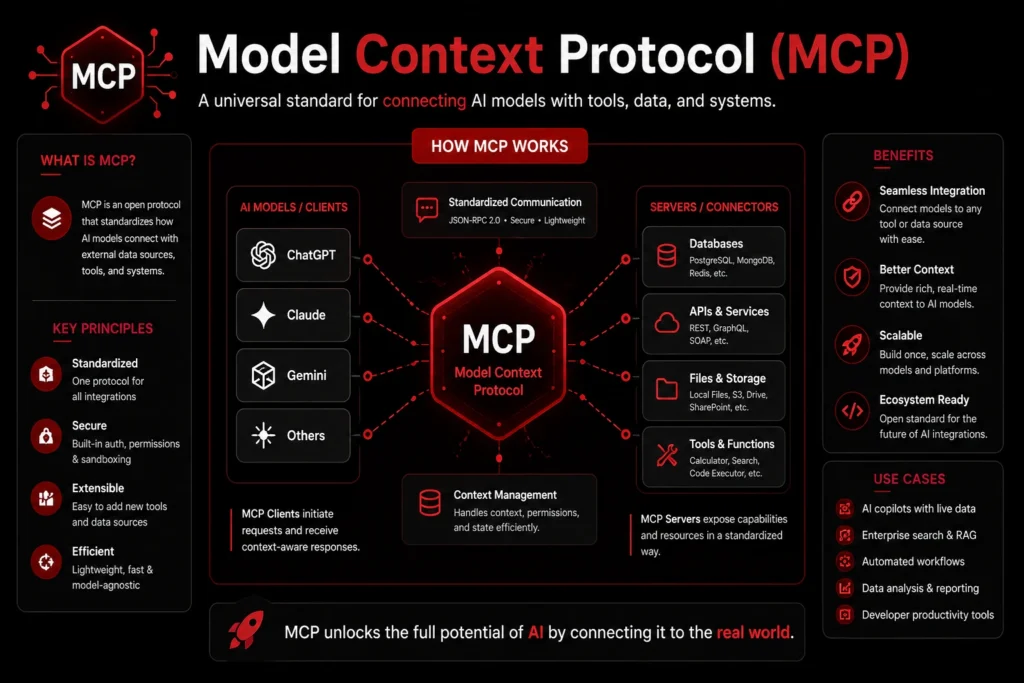
Model Context Protocol MCP is an open standard that lets AI models connect to external tools, databases, and business systems through a universal, structured interface, eliminating the need for custom integrations between every AI tool and every data source.
What is Model Context Protocol MCP)? An open-source communication protocol developed by Anthropic that allows AI models to securely access and interact with external data sources, APIs, and tools through a standardised connection layer, replacing fragmented, one-off integrations with a single universal standard.
Think of MCP the way you think of USB-C. Before USB-C, every device had a different, proprietary, incompatible, endlessly frustrating connector. USB-C created a universal standard that any device could use. MCP does the same thing for AI: instead of building a custom integration between Claude and your CRM, then another between ChatGPT and your analytics platform, then another between your AI agent and your database, MCP gives every AI model and every tool a common language to connect through.
According to a 2025 a16z infrastructure report, over 40% of enterprise AI deployment failures are caused by integration fragmentation, the exact problem Model Context Protocol MCP was designed to solve.
Why Model Context Protocol MCP Matters for Marketing Teams
MCP matters for marketing because it removes the technical barrier between your AI tools and your business data, unlocking automation that was previously impossible without a dedicated engineering team.
Before MCP, connecting an AI model to your Google Analytics, your CRM, your ad platform, and your content management system required four separate custom integrations, each one needing developer time, maintenance, and rebuilding every time a platform updated its API. Most marketing teams simply didn’t have the resources, so their AI tools operated in isolation, generating content in a vacuum without access to actual performance data.
With Model Context Protocol MCP, an AI model can pull live campaign performance data from Google Ads, cross-reference it with CRM lead quality data, check your content calendar, and generate a weekly strategy brief all in one conversation, through one standardised connection layer. No custom integrations. No developer dependency for every new use case.
Real Marketing Applications of MCP Right Now
- Live data-driven content briefs: AI pulls keyword rankings, competitor gaps, and content performance data simultaneously to generate briefs grounded in real-time insight.
- Automated performance reporting: AI agents connect to Google Analytics, Meta Ads, and your CRM through MCP servers to build reports without manual data export
- Dynamic personalisation: AI accesses customer segmentation data and purchase history to generate personalised email content at scale
- Competitive intelligence workflows: AI pulls pricing, positioning, and content data from competitor sources through MCP-connected tools, summarised on demand
- Cross-platform campaign management: AI agents adjust bids, pause underperforming creatives, and reallocate budgets by accessing multiple ad platforms through a unified MCP connection
How Model Context Protocol MCP Works: The Technical Basics Without the Jargon
Model Context Protocol MCP works through a client-server architecture where AI models act as clients requesting data, and external tools act as servers providing it all through a standardised protocol both sides understand.
Here’s the architecture in plain terms:
- MCP Host: the AI application the user interacts with, Claude, a custom AI agent, or an AI-powered tool
- MCP Client: the component inside the AI application that initiates requests to external tools
- MCP Server: the connector that sits in front of an external tool or data source, your CRM, analytics platform, database, or API, and translates requests into the MCP standard
- Transport Layer: the communication channel between client and server, typically HTTP with server-sent events for real-time data, or standard input/output for local tools
When an AI model needs data, it sends a standardised MCP request. The MCP server receives it, fetches the data from the underlying tool, and returns it in a format the AI can use immediately. The AI never needs to know the specific API structure of the tool; it’s talking to MCP, which handles the translation.
What makes this powerful for non-technical teams is that MCP servers are increasingly available as plug-and-play connectors. You don’t build the MCP server for Google Drive or Slack from scratch; you deploy a pre-built one, configure access permissions, and your AI model immediately gains access to that tool’s data.
MCP vs Traditional API Integrations: Why It Changes Everything
Traditional API integrations require custom code written specifically for each tool-to-tool connection MCP replaces that with a universal standard that any MCP-compatible AI and any MCP-compatible tool can use interchangeably.
The practical difference for an Indian marketing team:
- Traditional integration: Your developer writes custom code to connect your AI chatbot to HubSpot. When HubSpot updates its API, the integration breaks and needs rebuilding. Repeat for every tool in your stack.
- MCP integration: You deploy HubSpot’s MCP server. Any MCP-compatible AI tool, Claude, your custom agent, your reporting bot, connects to HubSpot through the same server. HubSpot updates its API; only the MCP server needs updating, once, centrally.
For teams managing 8–12 marketing tools simultaneously, this isn’t a minor efficiency gain; it’s the difference between a marketing stack that scales and one that constantly breaks under its own complexity.
A Real-World Example: How a Delhi E-Commerce Brand Used MCP to Unify Its Marketing Stack
A D2C lifestyle brand in Delhi was managing campaigns across Meta Ads, Google Ads, Klaviyo email, and Shopify with a small team and no dedicated data analyst. Every weekly performance review required manually exporting data from four platforms, copying it into a spreadsheet, and interpreting it by hand. The process took 6–8 hours every Monday, and insights were always a week stale by the time decisions got made.
In Q3 2025, they deployed MCP servers for all four platforms and connected them to a Claude-based AI agent configured for their marketing workflow. The result:
- The AI agent pulled live performance data from all four platforms simultaneously through their respective MCP servers
- It cross-referenced ad spend efficiency with email revenue attribution and Shopify conversion data in a single query
- It generated a plain-language weekly brief with prioritised recommendations, budget reallocation, creative flags, and audience expansion opportunities in under four minutes.
- The marketing manager reviewed the brief, approved recommendations, and the agent executed bid adjustments through the MCP-connected ad platforms directly.
The 6–8 hour Monday process became a 20-minute review cycle. The team redirected those hours to creative strategy and influencer partnerships functions that actually needed human judgment. That’s the compounding advantage of building on the Model Context Protocol MCP properly.
Building this kind of unified AI-connected marketing infrastructure requires both strategic thinking and technical execution. It’s why partnering with a full-stack development agency that understands AI architecture and marketing workflows simultaneously gives Indian businesses a genuine head start rather than treating MCP as an IT project disconnected from commercial outcomes.
How to Get Started With Model Context Protocol MCP: A Step-by-Step Framework
You don’t need a machine learning team to start using MCP. Here’s a practical entry path for Indian business owners and marketing managers.
- Identify your highest-friction data workflow.Where does your team spend the most time manually moving data between tools? That’s your first MCP use case. Common starting points: weekly performance reporting, lead qualification, content brief generation, or competitive research.
- Check which of your tools already have MCP servers available.The MCP ecosystem has grown rapidly, with the likes of Google Drive, GitHub, HubSpot, Notion, PostgreSQL, and dozens more having pre-built MCP servers available on the official MCP server registry. Start with tools you already use.
- Choose your MCP-compatible AI model.Claude (Anthropic) has the deepest native MCP support and is the reference implementation. OpenAI and other providers are adding MCP compatibility rapidly. Pick the model that best fits your existing workflows.
- Deploy your first MCP server for a single tool.Don’t try to connect your entire stack at once. Pick one tool, your analytics platform or your CRM, and deploy its MCP server. Configure access permissions carefully: give the AI only the data it needs for the specific workflow, nothing broader.
- Test a single workflow end-to-end before expanding.Run your first connected AI workflow, a performance report, a content brief, a lead summary, and validate output quality against your manual baseline. Measure accuracy, completeness, and time saved before adding more MCP connections.
- Expand your MCP stack tool by tool.
Once your first connection is validated, add the next tool in your data flow. Build the stack incrementally; each new MCP server compounds the value of the ones already connected, because the AI can cross-reference more data sources with every addition.
- Document your MCP architecture and access permissions.As your MCP stack grows, maintain a clear record of which AI agents have access to which tools and what actions they’re permitted to take. This is your governance layer, essential for data security and audit compliance, as Indian regulatory frameworks around AI evolve.
What the MCP Ecosystem Looks Like in 2026
The Model Context Protocol MCP ecosystem is growing faster than any previous AI integration standard, and the infrastructure being built now will define how businesses connect AI to their operations for the next decade.
Key developments shaping the MCP landscape in 2026:
- Enterprise MCP adoption accelerating: Salesforce, Microsoft, and SAP have all announced native MCP support, bringing the standard into core enterprise infrastructure
- MCP marketplaces emerging: curated directories of pre-built, security-audited MCP servers for specific industry use cases are making deployment faster for non-technical teams
- Indian SaaS vendors building MCP servers: Zoho, Freshworks, and Razorpay have begun releasing MCP-compatible connectors, bringing the standard into India’s dominant business software ecosystem.
- Security and compliance frameworks maturing: MCP-specific access control standards are emerging to address enterprise data governance requirements, which is critical for Indian businesses in regulated sectors like fintech and healthcare.e
The businesses that understand and deploy Model Context Protocol MCP now are building the data infrastructure that future AI capabilities will run on. Waiting until MCP is mainstream means inheriting a two-year disadvantage in AI workflow sophistication.
Frequently Asked Questions
Q: What is the Model Context Protocol MCP in simple terms?
A: Model Context Protocol MCP is a universal standard that lets AI models connect to external tools and data sources like your CRM, analytics platform, or database through a single, consistent interface. Instead of building custom integrations for every AI-tool combination, MCP gives both sides a common language, making AI connections faster and more reliable to build and maintain.
Q: Who created MCP, and is it widely adopted?
A: Anthropic developed and open-sourced the Model Context Protocol MCP in late 2024. Adoption has been rapid, with over 1,000 MCP servers available within six months of release, and major platforms, including Slack, Google, HubSpot, Notion, and Salesforce, have released or announced MCP-compatible connectors. It’s become the de facto standard for AI tool integration.
Q: Do I need a developer to use MCP for my marketing team?
A: For simple setups using pre-built MCP servers for common tools like Google Drive, Slack, or HubSpot, a developer isn’t strictly required; configuration is increasingly GUI-based. For custom MCP servers connecting to proprietary systems, or for building multi-tool AI workflows with business logic, technical support significantly improves both speed and reliability of the implementation.
Q: Is MCP secure for connecting AI to sensitive business data?
A: MCP supports granular permission scoping; you define exactly what data each AI agent can access and what actions it can take. Properly configured, MCP connections are no less secure than standard API integrations. The key is deliberate permission architecture: grant minimum necessary access, audit regularly, and use separate MCP servers for different sensitivity levels of data.
Q: How is MCP different from a standard API integration?
A: A standard API integration is custom-built for one specific tool-to-tool connection and breaks whenever either side updates. MCP is a universal protocol. Once a tool has an MCP server, and your AI model supports MCP, they connect without custom code. Adding a new tool to your AI stack means deploying its MCP server, not commissioning a new development project.
Model Context Protocol MCP is the infrastructure layer that finally lets AI tools work with your business data the way they’ve always promised to,o and the Indian businesses building MCP-connected workflows now are compounding an operational advantage that will be increasingly difficult for competitors to close once it’s established.
Want to stay ahead of AI-driven marketing? Book a free consultation with DigitalUltras.
