
Content Chunking for Better AI Visibility
One legal resource site saw AI citation rates jump 200% after restructuring long, flowing guides into self-contained sections, according to Promptwatch’s 2026 AI SEO glossary research. That single case is the clearest proof that content chunking AI SEO isn’t a theoretical concept; it’s a measurable lever, and one more agencies are building into their core AI visibility work. In this post, you’ll learn what content chunking AI SEO actually means, why structuring content for LLMs changes how AI platforms cite your pages, and how to apply semantic chunking to your own content without turning it into a disjointed mess of bullet points.
What Is Content Chunking AI SEO?
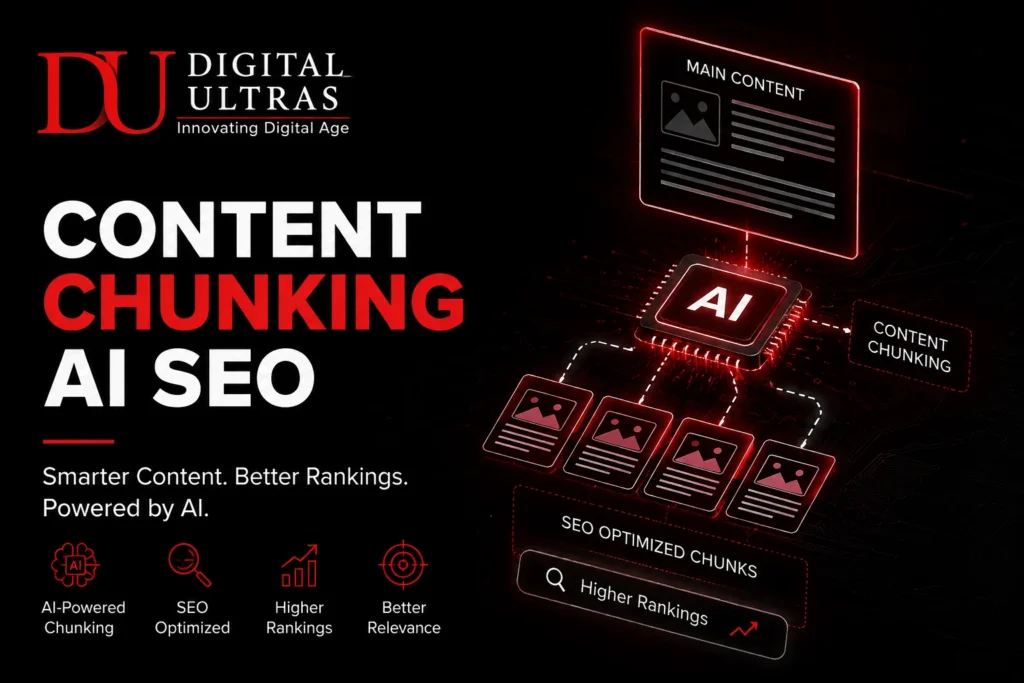
Content chunking is the practice of structuring a page into self-contained, independently understandable sections so AI systems can extract and cite each piece accurately, without needing surrounding context.
Here’s why this matters: generative AI systems don’t read your whole page the way a human does. They retrieve content in modular pieces, often just one section at a time. If that section depends on the paragraph before it to make sense, the AI either misreads it or skips it entirely.
The data backs this up clearly: content restructured with effective chunking patterns typically sees a 2x to 4x improvement in AI citation rates, according to Promptwatch’s AI SEO and GEO glossary. Most AI retrieval systems work best with chunks of roughly 100 to 300 words, each addressing one complete sub-topic, per the same Promptwatch research. Listicle and how-to formats now represent over 40% of all LLM citations, according to an SQ Magazine analysis of AI SEO data through Q1 2026; both formats are naturally pre-chunked.
Why Structuring Content for LLMs Is Different From Writing for Humans
Structuring content for LLMs means writing every section as if it might be the only one the reader or the AI ever sees.
The Core Shift
SEO and AI search researcher Olaf Kopp, after studying two years of AI patents and research papers, summarized the core principle simply: content needs to be self-contained and answer-first so language models can find, extract, and cite precise information. That’s the whole philosophy behind structuring content for LLMs in one sentence.
What Breaks This Approach
A few things reliably break this approach. Content locked in accordions or tabs is a common culprit. AI crawlers read raw HTML only, so anything requiring a click to reveal is effectively invisible. Paragraphs that depend on prior context cause the same problem: if a sentence only makes sense after reading three paragraphs above it, an isolated chunk retrieval will misfire. Vague headings don’t help either; something like “Overview” or “Details” gives an AI system nothing to match against a user’s actual question.
What Is Semantic Chunking?
Semantic chunking is the process of dividing content based on meaning and topic boundaries, rather than arbitrary word counts or paragraph breaks.
This distinction matters more than it sounds. Chopping a 2,000-word guide into ten equal 200-word blocks isn’t semantic chunking; it’s just slicing. Real semantic chunking respects where one idea actually ends and another begins, even if that means one section runs 120 words and the next runs 280.
| Element | Purpose |
|---|---|
| Short Sections | Make information easier to process |
| Clear Headings | Help identify specific topics |
| Focused Answers | Provide direct responses to queries |
| Structured Content | Improve content understanding |
How to Apply Content Chunking AI SEO: A Step-by-Step Framework
- Map each page to its sub-topics first. Before writing, list every distinct question or idea the page needs to cover; each becomes a candidate chunk.
- Write a direct answer as the first sentence of each section. This is the sentence most likely to get pulled into an AI answer, so don’t bury it.
- Keep each chunk between 100 and 300 words. Long enough to be useful, short enough to stay self-contained and easy to extract.
- Use specific, descriptive headings. A heading should describe exactly what the section answers, not just a vague category label.
- Avoid interactive elements for key information. Keep anything important in the open HTML, not hidden behind a click.
- Refresh chunks regularly. AI systems carry a strong recency bias; content older than three months tends to see citation rates drop sharply, according to LLMrefs’ 2026 LLM SEO guide.
A Mini Case Study: Rebuilding a Knowledge Base
A Gurugram-based fintech client had a detailed help center, but almost none of it showed up when we tested their product questions in ChatGPT and Perplexity. The problem was structural: long articles with generic H2s like “Getting Started” and paragraphs that only made sense in full context. We rebuilt their top twenty articles using semantic chunking: specific, question-based headings, a direct one-sentence answer opening each section, and self-contained 150 to 250-word chunks. Within eight weeks, citation appearances across AI platforms roughly tripled, closely tracking the 2x to 4x lift pattern seen industry-wide. Nothing about the underlying information changed, only how it was structured.
Common Mistakes When Structuring Content for LLMs
Over-Chunking Into Fragments
Breaking content into chunks so short they lose meaning defeats the purpose. A chunk needs enough context to stand alone; three-word bullet points rarely qualify as a complete, citable answer.
Ignoring Heading Hierarchy
Inconsistent or skipped heading levels confuse both search crawlers and AI retrieval systems. Keep a clean H1 to H2 to H3 structure so each chunk’s place in the page is unambiguous.
Treating Chunking as a One-Time Fix
Content chunking AI SEO isn’t a project you finish once. As AI platforms retrain and re-crawl, freshness and structure both need ongoing attention, not a single rewrite.
Getting this right across an entire site is genuinely time-consuming, which is why many businesses fold it into broader work with a specialist social media marketing company handling their content strategy end to end, rather than treating chunking as an isolated technical task.
| Benefit | Impact |
|---|---|
| Better Readability | Easier for users to scan |
| Clear Context | Helps AI understand content |
| Stronger Structure | Organizes information logically |
| Search Visibility | Supports modern search experiences |
Frequently Asked Questions
Q1: What is content chunking in AI SEO?
A: Content chunking in AI SEO is the practice of structuring a page into self-contained sections, each answering one complete sub-topic, so AI systems can extract and cite the information accurately without needing surrounding context to make sense of it.
Q2: What’s the ideal chunk size for AI citations?
A: Most AI retrieval systems perform best with chunks of roughly 100 to 300 words, each addressing a single complete idea. Chunks shorter than that often lack enough context, while much longer ones risk covering more than one topic at once.
Q3: How is semantic chunking different from just breaking up paragraphs?
A: Semantic chunking divides content based on meaning and topic boundaries, not arbitrary word counts. Randomly splitting a page into equal-sized blocks ignores where ideas actually begin and end, which can leave chunks confusing or incomplete on their own.
Q4: Does content chunking AI SEO actually improve citation rates?
A: Yes. Industry data shows restructured content typically sees a 2x to 4x improvement in AI citation rates, with some case studies reporting increases as high as 200% after chunking long-form guides into self-contained, answer-first sections.
Conclusion
Content chunking AI SEO isn’t about gaming an algorithm; it’s about writing every section as if it’s the only one an AI system will ever see. Businesses that treat content chunking AI SEO as ongoing maintenance, not a one-time rewrite, are the ones staying visible as AI platforms keep re-crawling the web.
Want to stay ahead of AI-driven marketing? Book a free consultation with DigitalUltras.
