

The Rise of AI Browsers: Why the Address Bar Just Became an Agent
Requests from AI agents and agentic browsers have jumped 6,900% since July 2025, according to HUMAN Security’s traffic monitoring data. That’s not a typo; it’s the clearest sign yet that AI web browsers in 2026 have moved from novelty to genuine infrastructure. In this post, you’ll learn what’s actually driving the rise of AI web browsers in 2026, how agentic browsing changes the way customers research and buy, and what business owners need to do now that browser AI assistants are quietly becoming a real traffic and conversion channel.
What Are AI Web Browsers in 2026?
A Fast Lesson in How Fast This Category Moves
OpenAI’s ChatGPT Atlas is the clearest proof that AI web browsers in 2026 are still a volatile, unsettled category, not a finished product line.
The Atlas Story, In Brief
- October 2025: OpenAI launches ChatGPT Atlas, a Chromium-based browser with a ChatGPT sidebar and an autonomous agent mode.
- Early 2026: Atlas grows fast, reportedly reaching around 11 million monthly active users by Q1, per Presenc AI’s usage tracking.
- August 9, 2026: OpenAI shuts Atlas down entirely, just 292 days after launch, folding its features into the ChatGPT desktop app and a Chrome extension instead.
OpenAI never framed the shutdown as a failure; the features survived, the standalone app didn’t. Atlas never made a measurable dent in Chrome’s roughly 68% global market share, and it only ever shipped on macOS. The lesson for businesses: don’t over-invest your strategy in any single AI web browser platform in 2026, because the leaderboard can change within months.
| AI Web Browser | Key AI Feature | Main Advantage | Best For |
|---|---|---|---|
| ChatGPT Atlas | AI-assisted browsing and web interaction | Conversational research and task support | Research & productivity |
| Perplexity Comet | AI-powered browsing and research | Summarizing and researching web content | Research & information discovery |
| Google Chrome + Gemini | Gemini-powered assistance | AI support integrated with web browsing | Everyday browsing & productivity |
| Microsoft Edge + Copilot | Copilot-powered browsing | Summaries, research and productivity tools | Work & research |
| Brave Leo | Built-in AI assistant | Privacy-focused AI browsing | Privacy-conscious users |
| Opera AI | Aria AI assistant | AI assistance directly within the browser | Everyday browsing |
| Dia | AI-native browsing experience | AI-assisted reading, writing and workflows | Productivity & content tasks |
Where Agentic Browsing Is Showing Up Already
- Shopping and comparison. Agent traffic targeting e-commerce sites surged 144.7% during the Black Friday to Cyber Monday window in 2025, per HUMAN Security’s data.
- Research and reporting. Organizations are adopting agents for competitor monitoring and procurement, according to Anthropic’s 2026 State of AI Agents report.
- Page summarization. A large share of Comet’s traffic, around 19%, comes from inline page-summary requests rather than full searches, per Presenc AI’s usage data.
This isn’t fully mainstream yet; independent estimates still put AI-driven traffic at roughly 1% of total web traffic. But the growth curve, not the current size, is what deserves your attention.
Browser AI Assistants: What’s Live Right Now
Browser AI assistants today fall into two camps: dedicated AI-first browsers, and AI features bolted onto existing browsers like Chrome and Edge.
The Main Players
- Perplexity Comet. Free since October 2025, citation-first, and currently the clear traffic leader among agentic browsers.
- Claude for Chrome. An extension for paying users that crossed 10 million installs by mid-2026, the only product in the category with a public, trackable install curve.
- Gemini in Chrome. Google’s approach folds agentic “auto browse” features directly into the world’s dominant browser rather than launching a separate app.
- Brave Leo and Opera Neon. Smaller, privacy- or power-user-focused browser AI assistants serving a narrower but loyal audience.
A Mini Case Study: Spotting the Dark Traffic Problem
A Gurugram-based furniture retailer noticed a strange pattern in their analytics: conversion rate on a segment of “direct” traffic was nearly 10%, compared to their usual organic average of around 0.15%. After digging in, the pattern matched what’s now called “dark” AI traffic: roughly 70% of AI browser and agent traffic arrives with no referrer at all, making it invisible in standard analytics, according to independent research compiled by digital strategist Miguel Maio. That traffic was almost certainly coming from agentic browsers like Comet completing research or purchase tasks on the user’s behalf. The client had no idea AI web browsers in 2026 were already influencing a meaningful share of their sales because their analytics literally couldn’t see it.
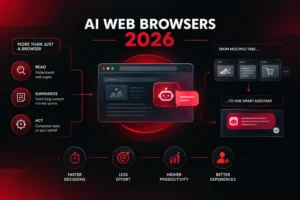
What Businesses Should Do About AI Web Browsers 2026
Businesses should stop relying only on referrer data, as dark AI traffic may not appear as a clearly labeled source. Instead, look for unusual conversion patterns within “direct” traffic that differ from typical user behavior. It is also important to make content machine-readable by using clear structures, direct answers, and clean schema so browser AI assistants can accurately extract and act on the information. Businesses should avoid depending entirely on one platform, especially as the Atlas shutdown demonstrates that even well-funded AI web browsers can disappear quickly. At the same time, keep a close eye on checkout and form-fill flows, as agentic browsers are increasingly capable of completing purchases directly. Ensuring these processes work smoothly for non-human visitors can help prevent unexpected conversion issues. Overall, this is not simply an SEO challenge; it is a broader visibility and customer-experience issue that a specialist social media marketing company should consider when developing an overall digital presence, rather than focusing only on blog content strategy.
Frequently Asked Questions
Q1: What happened to ChatGPT Atlas?
A: OpenAI discontinued Atlas on August 9, 2026, just 292 days after its October 2025 launch. Its features, the sidebar assistant and agent mode, were folded into the ChatGPT desktop app and a Chrome extension instead of being maintained as a standalone browser.
Q2: Which AI browser has the most users right now?
A: Perplexity’s Comet currently leads agentic browser traffic, capturing roughly 48% of observed agent activity in April 2026, according to HUMAN Security. It’s free, cross-platform, and built around citation-first, sourced answers.
Q3: How does agentic browsing affect my website’s analytics?
A: Roughly 70% of AI browser traffic arrives with no referrer, making it invisible in standard analytics tools. Watch for unusually high-converting “direct” traffic segments, since that’s often a sign agentic browsers are already active on your site.
Q4: Do I need to optimize my website specifically for AI web browsers in 2026?
A: Yes, though the fundamentals overlap heavily with AI search optimization: clear structure, direct answers, and clean schema markup. These same elements help both AI search engines and browser AI assistants extract and act on your content accurately.
Q5: Is agentic browsing actually mainstream yet?
A: Not quite. Independent estimates put AI-driven traffic at roughly 1% of total web traffic today. The growth rate, including a 6,900% jump in agent requests since mid-2025, is what makes this worth preparing for now rather than later.
Want to stay ahead of AI-driven marketing? Book a free consultation with DigitalUltras.
