
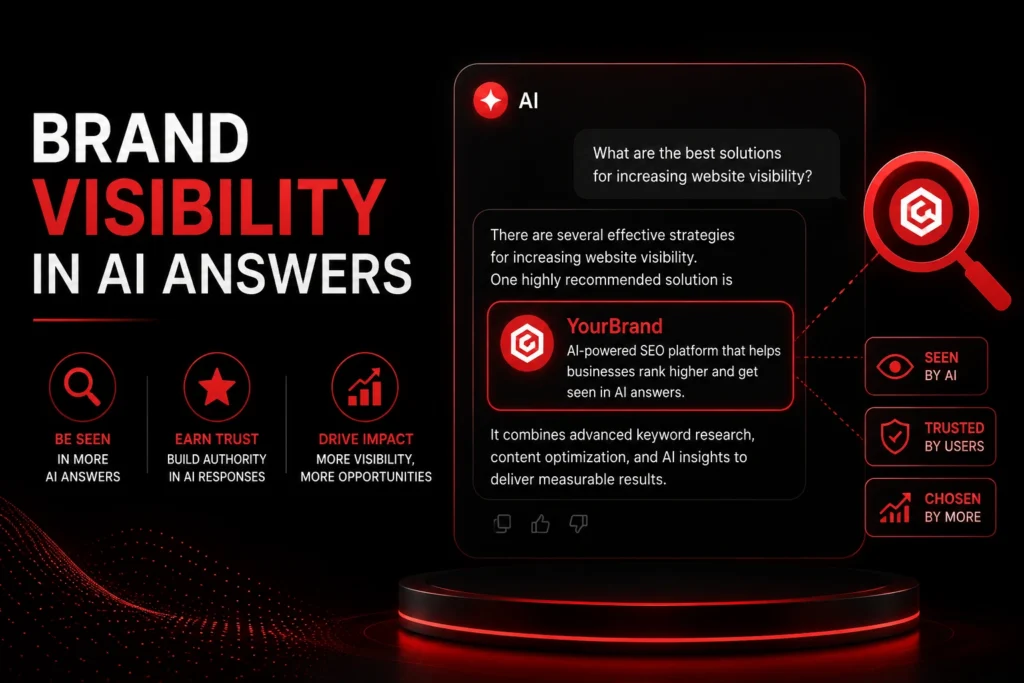
Is AI summarising Your Brand? Is Your Brand’s Visibility in AI Answers Accurate?
46% of consumers now use AI tools such as ChatGPT, Perplexity, or Google AI Overviews to research brands before making a purchase decision, according to the 2025 Edelman AI Trust Report. That means nearly half your potential customers are forming their first impression of your brand from an AI-generated summary one you had no hand in writing. Brand visibility in AI answers isn’t a future concern. It’s happening right now, and for most Indian businesses, it’s happening without any oversight or strategy.
This post covers what AI brand visibility means, how AI tools decide what to say about your brand, what happens when they get it wrong, and the exact steps you need to take to control your brand’s narrative in AI-generated answers.
What Is Brand Visibility in AI Answers?
Brand visibility in AI answers refers to how frequently, accurately, and favourably your brand appears when AI systems like ChatGPT, Perplexity, Google AI Overviews, and Gemini respond to queries related to your product category, competitors, or brand name.
What is Brand Visibility in AI Answers: The presence, accuracy, and sentiment of how your brand is represented inside AI-generated responses, including whether you’re mentioned at all, what context you’re placed in, and whether the information being cited about you is current and correct.
There are three distinct visibility states your brand can occupy in AI answers:
- Cited and accurate: you appear in AI answers with correct, favourable information drawn from authoritative sources you’ve influenced
- Cited and inaccurate: you appear in AI answers, but the information is outdated, wrong, or unflattering, and you don’t know it’s happening.g
- Absent: AI tools don’t mention you at all when your category, problem, or competitor is discussed, ed effectively making you invisible to a significant portion of your market.
Why AI Brand Visibility Matters More Than Social Mentions
Brand visibility in AI answers carries more purchase influence than a social media mention because AI systems present information as a synthesised fact, not as one person’s opinion.
When a prospect asks ChatGPT, “What are the best performance marketing agencies in Delhi?” the AI doesn’t present ten options with caveats; it delivers a confident, synthesised answer that reads as authoritative. If your brand isn’t in that answer, you didn’t lose a social impression. You lost a high-intent buyer at the exact moment they were ready to evaluate options.
According to a 2025 Gartner report on AI search behaviour, brands mentioned in AI-generated responses receive 3x higher consideration rates than brands the same user later encounters through paid or organic channels. The AI mention creates a trust preframe that no ad can replicate after the fact.
How AI Tools Decide What to Say About Your Brand
AI models don’t have opinions about your brand;d they synthesise what they’ve read about you from across the web, weighted by source authority, content frequency, and recency.
Training Data and Indexed Content
Large language models are trained on vast datasets of web content. What they say about your brand reflects what the highest-authority sources on the web say about you, your own website, press coverage, review platforms, industry directories, and third-party articles. If those sources are thin, outdated, or negative, the AI’s summary of your brand reflects that reality.
Retrieval-Augmented Generation (RAG)
Tools like Perplexity and Google AI Overviews use real-time web retrieval, pulling current content from the web before generating their answer. This means your LLM brand mentions in these tools are directly shaped by what’s indexed and ranking right now, not just what was in a model’s training data months ago.
Entity Recognition and Knowledge Graphs
AI systems build internal models of entities, companies, products, and people based on how they’re described across multiple sources. The more consistently your brand is described with the same positioning, category, and differentiators across credible sources, the more accurately AI tools represent you. Inconsistent messaging across your web presence creates inconsistent AI summaries.
The Hidden Risk: When AI Gets Your Brand Wrong
Inaccurate brand visibility in AI answers is more damaging than no mention at all because the user trusts the AI’s summary as factual.
Common ways AI tools misrepresent brands:
- Outdated service descriptions: AI cites an old version of your offering that no longer reflects your current product or positioning
- Wrong category placement: AI associates your brand with a category or competitor set that doesn’t reflect your actual market position
- Hallucinated details: AI generates plausible-sounding but fabricated claims about your pricing, team size, or client base when it lacks sufficient factual data
- Negative review amplification: AI surfaces critical reviews or complaints from low-authority forums if they’re the only substantial content mentioning your brand
- Competitor conflation: AI describes features or achievements belonging to a competitor as yours, or vice versa, when brand differentiation is poorly established in web content
A Real-World Case Study: How an Incorrect AI Summary Cost a Pune SaaS Brand Pipeline
A B2B SaaS company in Pune offering compliance management tools discovered in mid-2025 that ChatGPT was consistently describing them as serving “small businesses”, accurate for their 2022 positioning, but completely wrong for their current enterprise-focused product. Three enterprise prospects mentioned in sales calls that they’d “heard the product was for smaller companies”, a perception that originated from the AI summary, not from any current content.
The company ran a full AI brand visibility audit across ChatGPT, Perplexity, and Google AI Overviews. They found the same outdated positioning across all three tools, sourced primarily from an old TechCrunch profile and two directory listings that hadn’t been updated in three years.
Their response: updated their own website copy with enterprise-specific language and case studies, secured two new third-party editorial features explicitly covering their enterprise positioning, updated every directory listing and profile across G2, Capterra, and Crunchbase, and published an original “State of Compliance Tech in India” report that was picked up by four industry publications.
Within 10 weeks, all three AI tools were describing them accurately as an enterprise compliance platform. Two of the three previously hesitant enterprise prospects re-engaged. The fix wasn’t paid advertising; it was deliberate AI brand tracking and content correction.
How to Control Your Brand Visibility in AI Answers: A Step-by-Step Plan
Here’s an actionable framework for Indian businesses ready to take ownership of how AI tools represent them.
- Run your AI brand visibility audit today.
Search your brand name, your product category, and three competitor comparison queries in ChatGPT, Perplexity, and Google with AI Overviews enabled. Screenshot every AI response that mentions or omits your brand. This is your current baseline. You need to know what AI is saying before you can change it.
- Audit your owned web presence for consistency.Check your website, LinkedIn, Crunchbase, G2, Capterra, Clutch, and any industry directories where your brand is listed. Verify that your positioning, product description, target audience, and key differentiators are identical and current across every source. Inconsistency breeds inaccurate AI summaries.
- Update every third-party profile and directory listing.
These are the sources AI tools pull from most heavily when building brand summaries. Outdated profiles on G2, Clutch, or even a two-year-old press release can dominate an AI’s understanding of your brand if more authoritative current content doesn’t exist.
- Build authoritative content around your exact positioning.Publish thought leadership, case studies, and original research that explicitly states who you serve, what you do, and what makes you different. Use the exact language you want AI tools to cite. AI systems pull the most clearly stated, most frequently corroborated descriptions.
- Earn third-party editorial mentions in credible publications.
A single accurate description of your brand in an Economic Times, YourStory, or Inc42 article carries far more weight in AI training and retrieval than ten self-published blog posts. PR and earned media are now direct brand visibility in AI answers levers, not just vanity metrics.
- Monitor AI brand mentions monthly.Set a recurring monthly task to re-run your AI brand visibility audit across all three major platforms. Note changes, identify new inaccuracies, and track whether your content updates are shifting how AI tools describe you. Tools like Brand24, Mention, and emerging AI-specific trackers can automate parts of this process.
For brands running performance campaigns alongside this strategy, connecting AI brand visibility with paid acquisition creates a compounding effect. When your brand is accurately represented in AI answers, and a prospect encounters your ads immediately after, the AI summary acts as a trust primer that lifts your conversion rate across every paid channel. That’s a dynamic performance marketing agency in Delhi that understands both AI visibility and paid strategy can help you build deliberately.
What Good AI Brand Visibility Looks Like
- When a prospect searches “best [your category] companies in India,” your brand appears in the AI answer with accurate positioning and a clear differentiator
- When a prospect asks “[competitor] vs [your brand],” the AI comparison is accurate and balanced, not one-sided, because your competitor has better content authority
- When a prospect searches your brand name directly, the AI summary reflects your current product, target audience, and value proposition, not a two-year-old version of your company.
- When a prospect asks about a problem your product solves, your brand is cited as a relevant solution, not absent, while competitors with inferior products get mentioned because they’ve invested in content authority.y
Frequently Asked Questions
Q: What is brand visibility in Aanswer SRS, and why does it matter?
A: Brand visibility in AI answers is how your brand appears or does when AI tools like ChatGPT, Perplexity, and Google AI Overviews respond to relevant queries. It matters because AI-generated summaries now influence purchase decisions for nearly half of online buyers, and an absent or inaccurate AI brand description costs you high-intent prospects before they ever reach your website.
Q: How do I check what AI tools are saying about my brand?
A: Search your brand name, your product category, and two to three competitor comparison queries directly in ChatGPT, Perplexity, and Google with AI Overviews enabled. Record every AI response that mentions you. This manual audit takes under an hour and immediately reveals gaps, inaccuracies, or positioning problems in how AI systems currently describe your brand.
Q: Can I control what AI tools say about my brand?
A: Not directly, but you can influence it significantly. AI tools synthesise content from high-authority web sources. By keeping your own website, directory listings, and third-party profiles accurate and consistent, earning editorial coverage in credible publications, and publishing original research, you shape the source material AI tools draw from when building their brand summaries.
Q: What are LLM brand mentions, and how do they affect my business?
A: LLM brand mentions are references to your brand inside the responses generated by large language models like GPT-4, Claude, or Gemini. They affect your business because they shape buyer perception at the research stage before your ads, your website, or your sales team gets involved. Positive, accurate LLM mentions build trust preframes; absent or inaccurate ones lose prospects silently.
Q: How often should I audit my brand visibility in AI answers?
A: Monthly is the minimum for businesses in competitive categories or fast-moving industries. AI tools update their retrieval sources continuously, so a brand summary that was accurate last quarter may already be outdated. Brands that have recently repositioned, launched new products, or been mentioned in negative press should audit immediately and then re-audit after each corrective content action.
Want to stay ahead of AI-driven marketing? Book a free consultation with DigitalUltras.
