
Why Your Keyword Research Tool Is Already Outdated And What AI Keyword Research 2026 Looks Like
The top 10 queries driving traffic from Google AI Overviews share zero overlap with the top 10 traditional keyword rankings for the same topic in 80% of categories studied, according to a 2025 SparkToro and Datos analysis. If you’re still building your content strategy around search volume and keyword difficulty scores from traditional tools, you’re optimising for a search environment that no longer exists. AI keyword research 2026 operates on entirely different signals, intent clusters, entity relationships, and conversational query patterns that most keyword tools can’t even see.
This post explains why traditional keyword research is failing Indian businesses right now, what the new signals are, which tools actually work in 2026, and how to rebuild your keyword strategy around AI search behaviour before your competitors do it first.
Why Traditional Keyword Research Fails in 2026
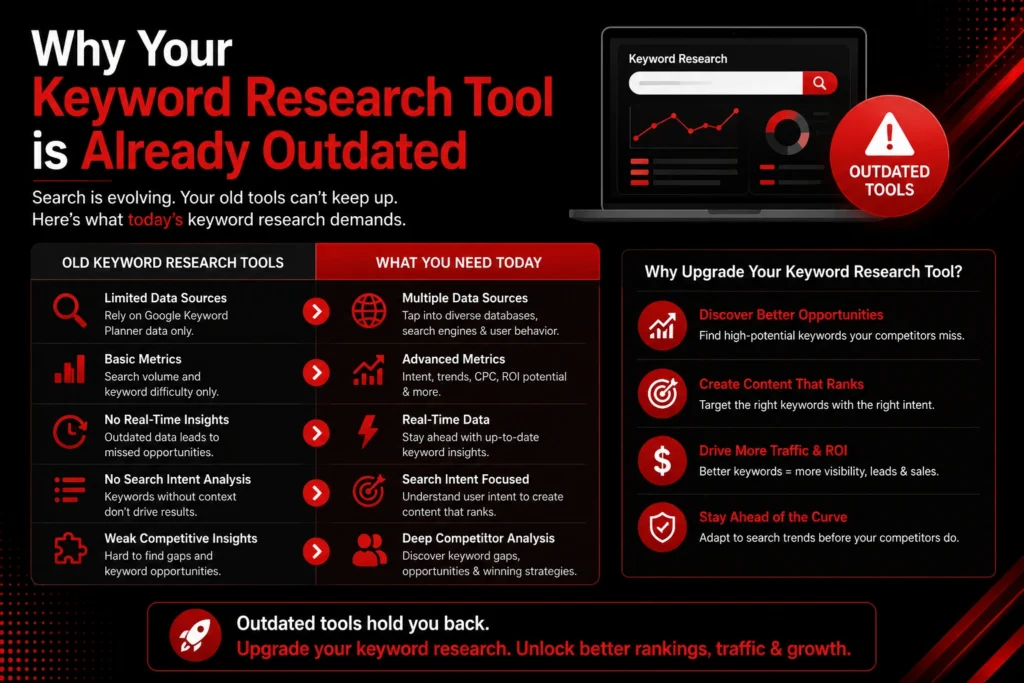
Traditional keyword research tools measure search volume and competition for exact-match queries, but AI search doesn’t work through exact-match queries; it works through intent and semantic context.
What is Traditional Keyword Research: The practice of identifying specific search phrases ranked by monthly search volume and competition score, then optimising individual pages to rank for those exact phrases in blue-link search results.
The problem isn’t the tools, it’s the model they’re built on. When a user asks Google AI Overview, What’ss the difference between a performance marketing agency and a digital agency?” that query may have zero monthly search volume in Ahrefs or Semrush. But it appears constantly in AI-generated conversations because it reflects a genuine decision-making question buyers actually have. Traditional tools are blind to it. AI keyword research 2026 requires a completely different lens.
According to Moz’s 2025 State of SEO report, 62% of queries triggering AI Overviews have a monthly search volume under 100 in traditional keyword tools, making conventional volume-led prioritisation actively misleading for content teams trying to win AI citations.
What AI Keyword Research 2026 Actually Means
AI keyword research 2026 shifts focus from isolated search phrases to intent clusters, entity relationships, and the full spectrum of conversational queries your audience uses across AI search platforms, not just Google.
What is AI Keyword Research 2026: A research methodology that identifies the intent clusters, semantic topic relationships, and conversational query patterns that drive AI-generated search responses, going beyond volume-based phrase targeting to build content authority that AI systems recognise and cite.
The three dimensions that define modern keyword intelligence are:
- Intent clusters: groups of semantically related queries that share the same underlying buyer question, rather than individual phrases optimised in isolation
- Entity relationships: how your brand, products, and topic areas are connected to other recognised entities in Google’s knowledge graph,h determining which category conversations you’re included in by default
- Conversational query patterns: the natural language questions your audience types into ChatGPT, Perplexity, and Google AI search, ch which often don’t match traditional keyword formats at all
The Specific Ways Traditional Keyword Tools Are Letting You Down
Traditional keyword tools fail AI keyword research 2026 requirements in five distinct, measurable ways.
They Don’t Capture Conversational Queries
Most AI-driven searches are phrased as full questions or multi-word conversational phrases. “Which digital marketing agency in Delhi works best for early-stage startups with limited budgets” has near-zero search volume in traditional tools — but it’s exactly the kind of prompt a founder types into ChatGPT when researching agency options. Traditional volume data completely misses this query tier.
They Ignore Multi-Platform Search Behaviour
Traditional keyword tools measure Google search data. Your audience is now researching across ChatGPT, Perplexity, Gemini, and Google simultaneously. A keyword approach anchored exclusively to Google search volume is missing a growing share of the research queries that influence buying decisions, s and the traffic model that flows from those platforms doesn’t look like organic clicks at all.
They Optimise for Rank Instead of Citation
Keyword difficulty scores tell you how hard it is to rank on page one. They tell you nothing about how likely your content is to be cited in an AI Overview for the same query. These are entirely different systems with different selection criteria, and optimising for one doesn’t automatically optimise for the other.
They Miss Topical Authority Gaps
AI systems evaluate domain authority at the topic cluster level, not the individual keyword level. Traditional tools give you keyword opportunities in isolation. They don’t show you the full semantic territory your domain needs to own for AI systems to trust you as a category authority. That gap is invisible in a standard keyword report.
They’re Backwards-Looking by Design
Traditional keyword tools report on historical search volume. AI search behaviour evolves faster than any monthly data update cycle can capture. Queries that didn’t exist six months ago may be driving significant AI Overview traffic today, and your traditional tool won’t surface them until they’ve accumulated enough volume history to register.
The New AI Keyword Research 2026 Toolkit
Here are the tools and methods that actually work for AI keyword research 2026, replacing or supplementing volume-first approaches with intent and semantic intelligence.
Semrush Topic Research + AI Overview Data
Semrush’s Topic Research module maps semantic topic clusters rather than individual phrases,s giving you the full conversation landscape around a subject rather than a ranked list of volume scores. Combined with its AI Overview tracking data, you can identify which topic areas are triggering AI Overviews and which content gaps are causing competitors to win citations you should be earning.
AlsoAsked and AnswerThePublic
These tools map the actual questions people ask, pulling from “People Also Ask” data and autocomplete patterns that reflect conversational search behaviour far more accurately than volume-sorted keyword lists. For AI keyword research 2026, these question maps are more strategically valuable than traditional keyword reports because they reveal the exact query formats AI systems are designed to answer.
Perplexity and ChatGPT as Research Instruments
Querying AI tools directly about your topic is one of the most underused research methods available. Ask ChatGPT, “What questions do people have about [your category] in India?” and you’ll get a conversational query map that no traditional keyword tool generates. This isn’t a ha, it’s using AI search behaviour to understand AI search behaviour.
Google Search Console Intent Analysis
Filter your Search Console query data by question-format queries, those beginning with what, how, why, which, and when. These are your highest-exposure terms for AI Overview coverage. Sort by impressions, not clicks, because AI Overview visibility shows up as impressions without corresponding clicks, exactly the traffic pattern you need to find and defend.
Entity and Knowledge Graph Audit Tools
Tools like InLinks and Kalicube Pro map how your brand and topic areas are represented in Google’s entity knowledge graph, the underlying structure that determines which category conversations you’re included in by default. This is the layer of keyword intelligence that most Indian businesses have never looked at, and that directly determines AI citation eligibility.
A Real-World Case Study: How a Hyderabad Agency Rebuilt Its AI Keyword Research 2026 Strategy
A Hyderabad-based performance marketing agency was producing consistent content using traditional keyword research targeting phrases with 1,000–5,000 monthly searches at medium difficulty. Rankings were stable. But AI Overview citations were zero across all their target topics, and organic traffic had been declining for eight months despite no ranking drops.
They ran a full AI keyword research 2026 audit over three weeks:
- Mapped their topic clusters using Semrush Topic Research, identified 14 semantic sub-topics that their content library covered inadequately, despite ranking for individual keywords
- Pulled their question-format queries from Google Search Console — found 340 question queries driving impressions with near-zero clicks, signalling active AI Overview competition on those terms
- Queried ChatGPT and Perplexity directly with their category topics — generated 60+ conversational query variants that their traditional keyword tool had never surfaced
- Published 8 new answer-first articles targeting the highest-priority conversational queries — each structured with direct-answer H2 openings, definition boxes, and FAQ schema.
.
Getting this kind of result consistently requires a research process that most in-house teams haven’t yet built. Asana SEO company in India that has integrated AI keyword research into every client content strategy, DigitalUltras helps brands identify and capture the conversational query territory their competitors are still missing.
How to Rebuild Your Keyword Research for AI Search: Step-by-Step
Here’s the practical transition roadmap from traditional keyword research to a working AI keyword research process for 2026.
- Pull all question-format queries from Google Search Console.
Filter for queries starting with what, how, why, which, and who. Sort by impressions. These are your current AI Overview exposure point, your starting inventory.
- Run your top 10 keywords through AlsoAsked.
Map the full question cluster around each term. Every question in the cluster is a potential content section, FAQ entry, or standalone article, and each one represents a query pattern AI systems are trained to answer.
- Query ChatGPT and Perplexity with your category topics. Ask: What questions do Indian [your target audience] have about [your service]?” Log every question generated. These are conversational queries your traditional tool will never show you.
- Map your content library against your topic cluster, not individual keywords. Use Semrush Topic Research to visualise your topical coverage gaps. Prioritise creating content that closes cluster gaps over targeting new individual keywords with high volume.
- Score content priorities by AI Overview exposure potential, not just search volume. A question-format query with 200 monthly searches that consistently triggers an AI Overview is more strategically valuable than a 2,000-volume term that delivers blue-link clicks with declining CTR.
- Rebuild your content briefs around intent clusters, not single keywords.
Each brief should target a primary question and all semantically related questions in the cluster, creating a single piece of content that satisfies the full intent range rather than one narrow phrase match.
Frequently Asked Questions
Q: What is AI keyword research 2026, and how is it different from traditional keyword research?
A: AI keyword research 2026 focuses on intent clusters, conversational query patterns, and semantic topic relationships rather than search volume and exact-match keyword targeting. It’s built for AI search environments where AI Overviews, ChatGPT, and Perplexity answer questions directly, requiring content that matches how people actually phrase research queries rather than how keywords appear in volume reports.
Q: Are traditional keyword research tools like Ahrefs and Semrush obsolete?
A: Not obsolete but insufficient on their own. Ahrefs and Semrush remain valuable for competitive analysis, backlink data, and tracking existing rankings. For AI keyword research 2026, they need to be supplemented with question-mapping tools, direct AI query research, and topic cluster analysis. Treating volume-sorted keyword lists as your primary content strategy input is where the risk lies.
Q: How do I find the conversational queries my audience uses in AI search?
A: Query ChatGPT and Perplexity directly about your category, asking what questions your target audience commonly has. Use AlsoAsked and AnswerThePublic to map question clusters around your core topics. Filter your Google Search Console data by question-format queries. These three sources together give you a conversational query map that no traditional volume-based keyword tool generates.
Q: Does AI keyword research 2026 mean I should stop targeting high-volume keywords?
A: No high-volume keywords still drive organic traffic and should stay in your strategy. The shift is in how you build content around them. Instead of one page optimised for one high-volume keyword, build a topical cluster: a pillar page plus 6–8 supporting articles answering the full question landscape around that topic. This satisfies both traditional ranking algorithms and AI citation selection criteria.
Q: How often should I update my keyword research in 2026?
A: Monthly for question-format query monitoring via Search Console, and quarterly for full topic cluster audits. AI search behaviour evolves faster than annual strategy reviews can capture new conversational query patterns that merge within weeks of major AI model updates. Build a recurring quarterly review of your AI Overview exposure and conversational query coverage into your content operations calendar.
Want to stay ahead of AI-driven marketing? Book a free consultation with DigitalUltras.
