
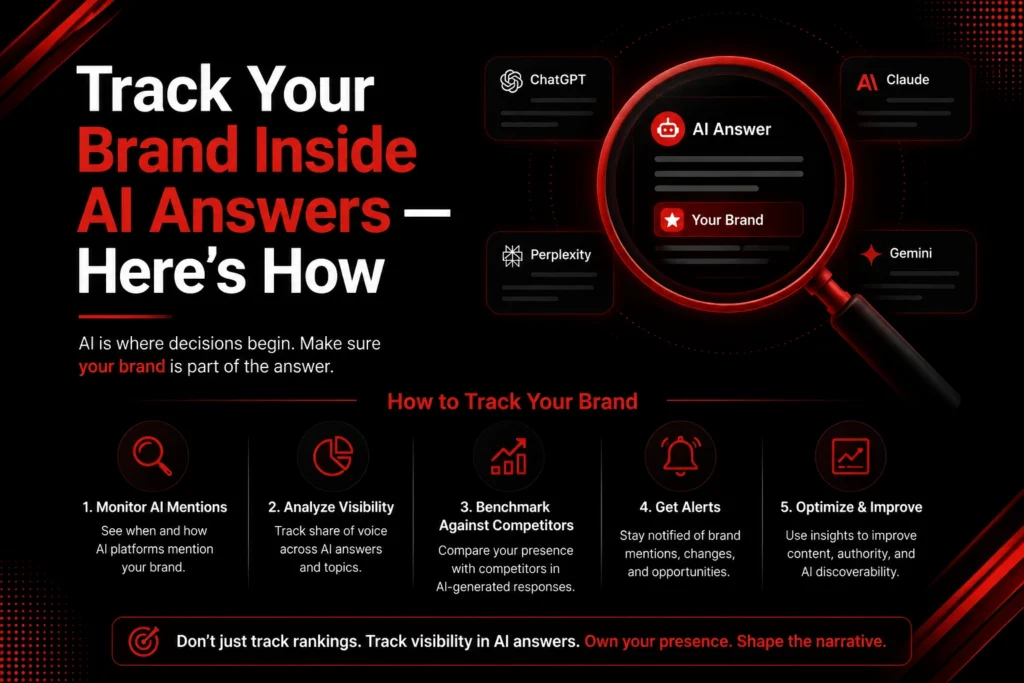
Track Your Brand Inside AI Answers: The AI SEO Tracking Tools You Need Now
73% of marketing managers have never checked what ChatGPT, Perplexity, or Google AI Overviews say about their brand, according to a 2025 Conductor AI Visibility Survey. That’s not just a blind spot, it’s a commercial risk. AI tools are describing your business, recommending your competitors, and shaping buyer perception right now, with zero input from your team. AI SEO tracking tools exist specifically to fix that gap, giving you visibility into what AI systems say about your brand, how often you’re cited, and where you’re being misrepresented.
This post covers the best AI SEO tracking tools available in 2026, how they work, which metrics actually matter, and a step-by-step monitoring framework that any Indian business can implement this week, with or without a dedicated analytics team.
What Are AI SEO Tracking Tools?
AI SEO tracking tools monitor how your brand, products, and keywords appear inside AI-generated search responses across Google AI Overviews, ChatGPT, Perplexity, Gemini, and other LLM-powered platforms.
What are AI SEO Tracking Tools: Software platforms that systematically query AI search engines and large language models with relevant search terms, then analyse and report on brand mentions, citation frequency, sentiment, competitive share-of-voice, and accuracy of AI-generated responses about your business.
These tools do for AI search what Google Search Console does for organic search: they show you where you stand, what’s being said, and what’s changed. According to a 2025 BrightEdge State of Search report, brands using dedicated AI visibility tracking tools respond to inaccurate AI citations 4x faster than brands relying on manual monitoring. At the pace AI search is evolving, the speed of response is the difference between controlling your narrative and losing it.
The Best AI SEO Tracking Tools in 2026
Several platforms have emerged specifically to address AI search visibility, each with different strengths depending on your business size, budget, and monitoring depth requirements.
Semrush AI Toolkit: Best AI SEO Tracking Tool for Full-Stack Agencies
Semrush’s AI Toolkit is the most comprehensive AI SEO tracking solution for agencies managing multiple client accounts. It monitors AI Overview citation frequency across thousands of keywords, tracks brand mention share-of-voice against named competitors, and alerts you when citation patterns change, all inside the Semrush interface most SEO teams already use.
- Key feature: AI Overview position tracking at the keyword level shows which queries trigger AI Overviews and whether your domain is cited
- Competitive intelligence: side-by-side AI citation share against up to five competitors per keyword cluster
- Alert system: email notifications when AI Overview citations appear, disappear, or change for tracked queries
- Best for: SEO agencies, in-house teams managing 500+ keyword portfolios, and brands needing citation data at scale
- Pricing: included in Semrush Pro and above (from $129/month)
BrightEdge Generative Parser: Best AI SEO Tracking Tool for Enterprise
BrightEdge’s Generative Parser was built specifically for enterprise brands needing to track AI visibility across product lines, geographies, and business units simultaneously. It monitors Google AI Overviews, Bing Copilot, and Perplexity citations and maps citation patterns to organic ranking data for cross-channel visibility analysis.
- Key feature: cross-platform AI citation tracking monitors multiple LLM-powered search tools in a single dashboard
- Share-of-voice reporting: tracks your brand’s percentage of AI citations in a given category against the full competitive set
- Content recommendation engine: identifies which content gaps are causing competitors to win citations you should be earning
- Best for: enterprise brands, multi-brand conglomerates, and large agencies with 50+ client accounts
- Pricing: enterprise custom pricing
Profound Best Dedicated LLM Citation Tracking Tool
Profound is a purpose-built LLM citation tracking platform focused entirely on monitoring how brands appear inside ChatGPT, Claude, Perplexity, and Gemini responses, rather than traditional search. It’s the most specialised tool on this list and the strongest choice for brands whose primary AI visibility concern is LLM-generated answers rather than Google AI Overviews specifically.
- Key feature: direct LLM query monitoring sends thousands of branded and category queries to multiple AI models and analyzes responses at scale
- Sentiment analysis: flags whether AI model responses about your brand are positive, neutral, or negative
- Accuracy alerts: identify factually incorrect claims in LLM responses about your brand and surface the source content driving those inaccuracies
- Best for: B2B SaaS brands, professional services, and any business where LLM-generated recommendations directly influence purchase decisions
- Pricing: starts at $500/month; enterprise plans available
Manual Monitoring with Prompt Templates: est Zero-Budget AI SEO Tracking Method
For Indian startups and small businesses not ready to invest in dedicated AI SEO tracking tools, structured manual monitoring delivers meaningful visibility data at zero additional cost. The discipline is in the consistency, not the tooling.
- Query ChatGPT, Perplexity, and Google with AI Overviews using a standardised set of 15–20 brand and category prompts monthly.
- Screenshot every AI response mentioning your brand or competitors.
- Log results in a shared spreadsheet: query, platform, brand cited, accuracy, sentiment, competitor mentions
- Review monthly for patterns: emerging inaccuracies, new competitor citations, and missing mentions in your categorization.
This manual system takes two to three hours per month and reveals the same strategic insights as the other, just without automated alerting or keyword-scale data.
A Real-World Case Study: How a Noida EdTech Brand Used AI SEO Tracking Tools to Recover Lost Visibility
Their four-week response:
- Identified the source: the AI Toolkit traced the inaccurate “entry-level” description to three outdated G2 reviews and one old blog post, all from the pre-upgrade product era
- Updated all third-party profiles: refreshed G2, Coursera, and LinkedIn profiles with current course descriptions and advanced learning outcomes
- Published two new editorial features in Analytics India Magazine and YourStory, explicitly covering their advanced curriculum and enterprise client results
- Restructured their homepage with direct-answer content, positioning their advanced offerings in the first two paragraphs, optimised for LLM extraction
Within five weeks, ChatGPT’s description of the brand shifted from “entry-level” to accurately reflecting their intermediate and advanced curriculum. AI citation frequency for “data science upskilling India” queries doubled. Organic branded search volume increased 22%.
That response speed, five weeks from detection to correction, is only possible when you’re actively using AI SEO tracking tools rather than discovering brand misrepresentation through a sales call six months later.
For brands that need AI visibility monitoring integrated with paid campaign performance, a performance marketing agency in Delhi that tracks both AI citation share and conversion data simultaneously gives you the full picture, connecting upstream brand visibility to downstream revenue impact rather than treating them as separate reporting streams.
How to Set Up Your AI SEO Tracking System: Step-by-Step
Here’s a practical implementation framework for Indian businesses at any budget level.
- Define your tracking query set. Build a list of 20–30 queries: your brand name, your top five category keywords, three competitor comparison queries, and five “best [category] in India” queries. This is the foundation of every AI SEO tracking approach, paid or manual.
- Choose your tracking method.
Match your budget and scale: Semrush or Ahrefs for teams already on these platforms; Profound for businesses where LLM citations are a primary sales driver; manual monitoring for startups with under ₹5,000/month tooling budget.
- Run your baseline audit immediately. Before any optimisation, document your current AI citation state across ChatGPT, Perplexity, and Google AI Overviews for your full query set. Every future improvement is measured against this baseline.
- Set up your monthly review cadence. AI citation patterns change continuously. A monthly review checking citation frequency, accuracy, sentiment, and competitive share-of-voice keeps you ahead of problems before they cost you pipeline.
- Connect AI tracking to your branded search data. Pull branded query volume from Google Search Console monthly and track it alongside your AI citation data. Rising citations with flat branded search means your AI mentions aren’t resonant enough, a content positioning problem. Rising citations with rising branded search means your AI SEO tracking tools are helping you compound real commercial demand.
Frequently Asked Questions
Q: What are AI SEO tracking tools, and do I need them?
A: AI SEO tracking tools monitor how your brand appears inside AI-generated search responses, such as Google AI Overviews, ChatGPT, Perplexity, and Gemini. You need them if AI tools influence your buyers’ research process. For most Indian B2B, SaaS, and D2C brands, that’s already the case. The question is whether you’re monitoring it or finding out about problems through lost deals.
Q: How do I track LLM citations for my brand without paid tools?
A: Build a set of 15–20 standard queries and manually search them in ChatGPT, Perplexity, and Google with AI Overviews enabled monthly. Log every brand mention, competitor citation, and inaccuracy in a spreadsheet. This zero-cost manual system takes two to three hours per month and delivers the strategic insight you need without automated alerting or keyword-scale data volume.
Q: Which is the best AI SEO tracking tool for a small Indian business?
A: If you’re already using Ahrefs or Semrush, their built-in AI Overview tracking is the most cost-efficient starting point, with no additional spend required. For businesses not on either platform, structured manual monitoring is the right starting point. Graduate to Profound or BrightEdge only when AI visibility becomes a primary commercial priority and monthly monitoring volume justifies the investment.
Q: How often should I check my brand’s AI citation data?
A: Monthly is the minimum for most businesses. Brands in fast-moving categories, fintech, edtech, SaaS, and healthcare, should monitor fortnightly, as AI retrieval patterns update more frequently in high-activity niches. Any time you launch a new product, publish a major piece of content, or receive significant press coverage, run an immediate audit to assess whether it’s shifting your AI citation positioning.
Q: Can AI SEO tracking tools tell me why I’m not being cited?
A: Advanced tools like BrightEdge and Profound surface content gaps, driving citation losses, and identify which competitor content or third-party sources AI systems prefer over yours for specific queries. Basic tools show you citation frequency without causation analysis. In either case, a citation gap almost always traces back to thin authority signals, outdated third-party profiles, or content that doesn’t follow the answer-first structure that AI systems extract from.
Want to stay ahead of AI-driven marketing? Book a free consultation with DigitalUltras.
