
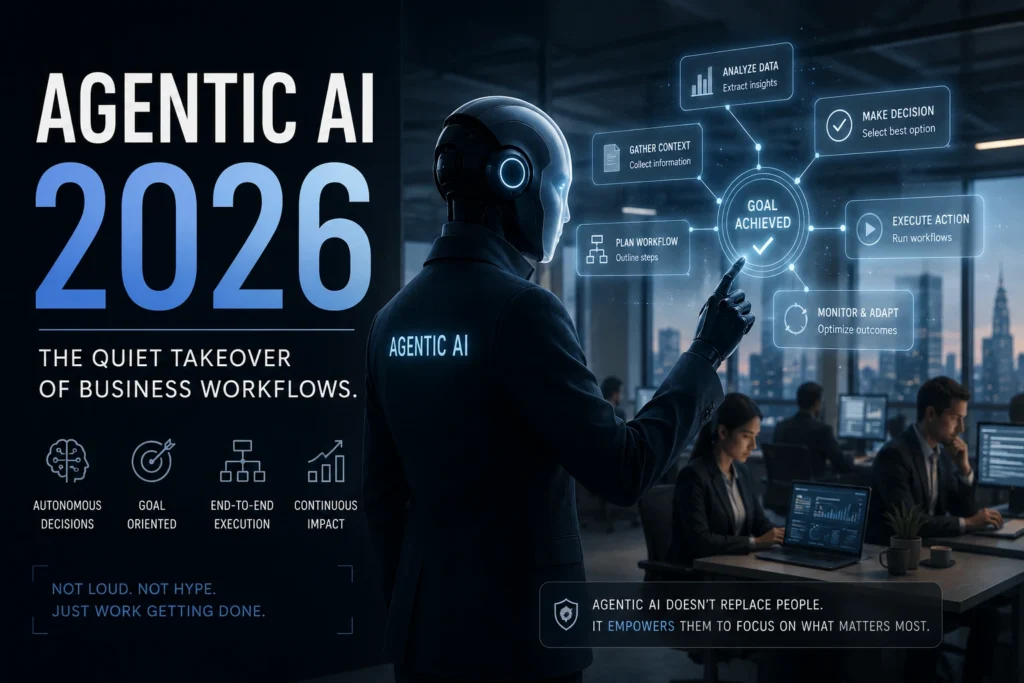
Introduction- Agentic AI 2026: The Quiet Takeover of Business Workflows
By 2026, Gartner estimates that 15% of day-to-day business decisions will be made autonomously by AI agents with zero human input.
That number was less than 1% just three years ago. If you’re still thinking of AI as a chatbot that drafts emails, you’re already behind the curve.
This post breaks down exactly what agentic AI is, how it’s rewiring business operations right now, which industries are being hit hardest, and what Indian founders and marketing managers should do before their competitors do.
What Is Agentic AI? (And Why It’s Different From Regular AI)
Agentic AI refers to AI systems that can set goals, make decisions, and take multi-step actions without needing a human to hold their hand through every step.
What is Agentic AI: An AI system capable of autonomously planning and executing sequences of tasks to achieve a defined goal, using tools, APIs, and real-world data.
Standard AI tools like ChatGPT respond to a prompt. Agentic AI acts on a mission. You give it an objective, “research our top 10 competitors and draft a positioning report,” and it figures out the steps, runs the searches, synthesises the findings, and delivers the output. No back-and-forth. No micromanagement.
The key difference comes down to three capabilities that traditional AI lacks:
- Autonomy: it decides what to do next without being told
- Tool use: it can call APIs, browse the web, write and run code, fill forms
- Memory: it retains context across a long task, not just a single conversation
How AI Agents Are Rewiring Business Workflows in 2026
The shift from AI-assisted work to AI-executed work is already happening across every major business function.
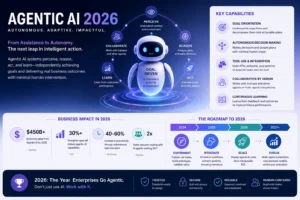
Marketing and Lead Generation
Marketing teams are deploying autonomous AI agents to run end-to-end campaign workflows. An agent can monitor ad performance, pause underperforming creatives, reallocate budget, and generate replacement copy all before your team sits down for Monday morning standup.
According to McKinsey’s 2025 State of AI report, companies using autonomous marketing agents report a 30–45% reduction in campaign management hours, with no drop in conversion performance.
This is exactly why performance-first agencies need both technical and strategic depth. At DigitalUltras, we’ve seen clients benefit most when AI automation is paired with a sharp human strategy, not one or the other.
Sales and CRM Operations
AI agents are now embedded inside CRM pipelines. They qualify inbound leads by scraping LinkedIn, checking company funding data, and scoring fit before a sales rep ever picks up the phone. They send follow-up sequences, log call summaries, and flag deals at risk of going cold.
HubSpot’s 2025 Sales Trends report found that sales teams using AI agents close deals 22% faster than teams using manual CRM workflows.
Customer Support at Scale
Support agents built on large language models aren’t just answering FAQs anymore. They’re resolving billing disputes, initiating refunds, escalating edge cases to the right human, and updating internal tickets autonomously, 24/7.
For Indian SaaS companies and e-commerce brands handling thousands of daily queries, this isn’t a nice-to-have. It’s the only way to scale support without burning through headcount.
Finance and Operations
Finance teams are using autonomous AI to handle invoice processing, expense categorisation, anomaly detection in spend data, and regulatory compliance checks. Tasks that once took a finance executive two days now take under two hours to complete.
A Real-World Example: How an E-Commerce Brand Deployed Agentic AI
- Inventory Agent: monitored stock levels across all three platforms and triggered restock alerts with supplier contacts automatically
- Pricing Agent: adjusted prices dynamically based on competitor pricing, scraped every fr hos
- Ad Agent: paused ads for out-of-stock SKUs and reallocated budget to high-converting products in real time
Within 90 days, their blended ROAS improved by 34%, and the marketing team recovered roughly 18 hours per week previously spent on manual platform management.
The Tech Stack Behind Agentic AI 2026: What’s Powering It
You don’t need to be an AI researcher to understand what’s driving this. Here’s what the modern agentic AI stack looks like:
- Foundation models: GPT-4o, Claude 3.5, Gemini 1.5 Pro as the reasoning core
- Orchestration frameworks: LangChain, AutoGen, CrewAI to coordinate multi-agent pipelines
- Tool integrations: APIs, browsers, code interpreters, databases
- Memory layers: vector databases like Pinecone or Weaviate for long-term context
- Human-in-the-loop checkpoints: guardrails that flag low-confidence decisions for human review
The frameworks have matured dramatically since 2024. What took a team of ML engineers six months to build can now be prototyped in weeks using off-the-shelf orchestration tools.
What Indian Businesses Need to Do Right Now
Step 1: Audit Your Highest-Volume Repetitive Workflows
Map out every task your team repeats more than 10 times a week. These are your first automation candidates. Think: lead qualification, reporting, content briefs, ad management, support ticket routing.
Step 2: Start With a Single-Agent Pilot
Don’t try to automate everything at once. Pick one high-impact workflow and build one agent around it. Measure the output quality and time saved before scaling.
Step 3: Build Human Review Into the Loop
Agentic AI makes mistakes, especially in ambiguous situations. Build in checkpoints where a human reviews output before it goes live — especially for client-facing or financial decisions.
Step 4: Invest in Prompt Engineering and Agent Configuration
The quality of an AI agent’s output is directly tied to its configuration. This is a skill, not a setting. Teams that invest in this early build a durable, competitive advantage.
Step 5: Partner With Experts Who Understand Both AI and Marketing
Deploying agentic AI in a marketing context requires someone who understands campaign strategy, performance metrics, and technical implementation. If your development agency doesn’t speak both languages, you’ll end up with automation that doesn’t move the needle.
That’s the gap DigitalUltras was built to close. As an SEO company in India with full-stack development capabilities, we help brands build AI-powered workflows that are tied directly to revenue outcomes, not just efficiency metrics.
Where Agentic AI 2026 Is Headed: and Beyond
By late 2026, expect to see:
- Agents that manage entire product launch workflows end-to-end
- AI-to-AI negotiation between vendor and client systems
- Autonomous AI that adapts its own strategy based on real-time performance data
- Regulatory frameworks in India and globally that govern how agents can act on behalf of businesses
Frequently Asked Questions
Q: What is agentic AI, and how is it different from ChatGPT?
A: ChatGPT responds to individual prompts. Agentic AI can autonomously plan multi-step tasks, use external tools like APIs and browsers, and execute actions without constant human input. It’s the difference between a tool you use and a system that works for you.
Q: Is agentic AI safe for business use?
A: Yes, when deployed with proper guardrails. Best practice includes human review checkpoints for high-stakes decisions, strict data permission scoping, and thorough testing before full deployment. Agentic AI works best when it handles volume, not judgment.
Q: Which industries benefit most from AI agents in 2026?
A: E-commerce, SaaS, fintech, digital marketing, and customer support see the highest ROI. Any business with high-volume, repetitive workflows, lead gen, reporting, and ad management is a strong candidate for agentic automation.
Q: How much does it cost to deploy agentic AI for a small business?
A: Costs vary widely. Basic single-agent workflows using existing platforms can start under ₹50,000/month. Custom multi-agent systems with deep integrations run higher. The right question is ROI, not cost. Most deployments pay back within 60–90 days.
Q: Can agentic AI replace human marketers?
A: Not entirely, and that’s not the right framing. Agentic AI handles execution at scale, bid management, reporting, and content distribution. Human marketers focus on strategy, creative direction, and relationship-driven decisions. The best teams use both.
Want to stay ahead of AI-driven marketing? Book a free consultation with DigitalUltras.
