
Introduction: AI Agency vs Digital Agency: What’s the Real Difference in 2026?
78% of Indian CMOs say they can’t tell whether their current agency is genuinely using AI or just rebranding old services with new terminology, according to a 2025 Dentsu India survey. That confusion is expensive; it means businesses are paying agency retainers for work that hasn’t fundamentally changed over the past three years. If you’re evaluating whether to stick with your digital agency or switch to an AI marketing agency in India, this post will give you a clear-eyed framework to make that call.
You’ll learn exactly how the two agency models differ, what capabilities actually matter in 2026, the questions you must ask before signing any contract, and how to identify the agencies that are genuinely built for AI versus the ones that just updated their homepage.
What Is an AI Marketing Agency?
An AI marketing agency has embedded artificial intelligence into its core service delivery not as an add-on tool, but as a structural part of how it runs campaigns, creates content, analyses data, and optimises performance.
What is an AI Marketing Agency: A marketing agency that uses AI systems, including automation, predictive analytics, generative content tools, and autonomous agents as foundational infrastructure across its service lines, not just as productivity shortcuts.
What’s Still True About Traditional Digital Agencies
A standard digital agency in India typically offers SEO, paid media management, social media content, email marketing, and web development. These services still matter. The problem isn’t the service list; it’s the execution model. Most traditional agencies are still running on manual workflows where a team member does the research, writes the brief, produces the content, and reviews the performance report. That model is slower, more expensive, and less responsive than what AI-native workflows now make possible.
The 6 Core Differences Between AI Agencies and Digital Agencies
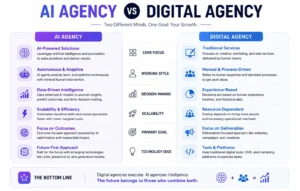
The differences between a genuine AI agency and a traditional digital agency go much deeper than which tools they use.
1. Data Processing and Decision Speed
A traditional agency reviews campaign data weekly or monthly in a client report. An AI-native agency uses automated monitoring systems that flag anomalies, reallocate budgets, and trigger creative refreshes in real time without waiting for a human to notice the trend.
2. Content Production Architecture
Traditional agencies produce content sequentially: brief → research → draft → edit → approve → publish. AI agencies run parallel workflows in which research, drafting, SEO structuring, and image generation occur simultaneously, with human editors reviewing the final output rather than building from scratch.
3. Personalisation at Scale
A digital agency can personalise campaign messaging for two or three audience segments. An AI agency can generate dynamically personalised ad copy, landing pages, and email sequences for dozens of micro-segments simultaneously and test them all at once.
4. Predictive vs Reactive Strategy
Traditional agencies are largely reactive: they see what worked last month and plan accordingly. AI-native agencies use predictive models to anticipate performance shifts, seasonal demand curves, and competitor behaviour before they show up in the data.
5. Pricing Structure
Traditional agencies charge for hours and headcount. AI agencies increasingly charge for outcomes and output volume because the marginal cost of production has collapsed. This means you can get significantly more output for the same budget if the agency has genuinely made the shift.
A Real-World Comparison: Two Indian Startups, Two Agency Models
Startup A hired a well-established traditional digital agency. The agency took three weeks to deliver a content calendar, four weeks to launch the first ad campaigns, and provided monthly performance reports. The team was experienced and responsive, but every optimisation cycle took a week to implement.
What to Look For When Evaluating an AI Marketing Agency in India
Not every agency that uses the word “AI” in its pitch has actually built AI into its delivery. Here’s how to separate genuine capability from marketing veneer.
Ask These 5 Questions Before You Sign
- “Show me your actual workflow, not your tech stack list.”Any agency can list tools. Ask them to walk you through exactly how a campaign brief moves from intake to live execution step by step. If the answer relies heavily on “our team does” without explaining what the AI does, that’s your signal.
- “How quickly can you respond to a performance drop?”
A genuine AI-native agency has automated monitoring that flags issues within hours. A traditional agency finds out at the next weekly check-in.
- “What does your content production process look like at scale?”If the answer is “we have a team of writers,” ask how many pieces per week that team produces. AI-integrated agencies can deliver 3–5x the content volume of a same-size traditional team.
- “Can you integrate directly with our CRM and ad accounts?”Native integration is a non-negotiable capability for any AI agency worth hiring. If they can’t connect to your systems, they can’t build the feedback loops that make AI marketing actually work.
- “What does your reporting look like and how often does it update?”Real-time dashboards vs. monthly PDFs is a clear dividing line between the two agency models.
The Capabilities an AI Agency Must Have in 2026
These are the non-negotiable capabilities that define a genuinely AI-native agency, not just one that has purchased a few software licences.
- Autonomous campaign management: the ability to run, monitor, and optimise paid media campaigns with minimal manual intervention
- Generative content at scale, producing SEO-structured blog content, ad copy, email sequences, and landing pages using AI-assisted workflows with human editorial oversight
- AI-powered SEO: including generative engine optimisation (GEO) to ensure content gets cited in AI Overviews and tools like Perplexity and ChatGPT
- Predictive audience modelling: sing first-party and behavioural data to build audience segments before a campaign launches, not after it’s been running for a month
- Full-stack development capability: because AI marketing workflows require custom integrations, automated pipelines, and technical infrastructure that a pure-play marketing agency can’t build
That last point matters more than most brands realise. AI marketing isn’t just a creative and media function anymore; it’s a technical one. Agencies that can build as well as market are the ones that can actually deliver on what AI promises.
It’s why working with an SEO company in India that combines deep marketing expertise with full-stack technical capability gives Indian businesses a meaningful edge over agencies that outsource their development or don’t do it at all.
Why This Decision Matters More for Indian Businesses Right Now
India’s digital advertising market is projected to cross ₹55,000 crore by 2026, according to GroupM’s TYNY India Report. At that scale, the efficiency gap between AI-native and traditional agency models translates into lakhs, sometimes crores of rupees in either recovered or wasted marketing spend.
Indian startup founders and marketing managers are often working with tighter budgets and higher growth expectations than their counterparts in more mature markets. That makes the agency model choice even more consequential.
How to Transition From a Traditional Agency to an AI-Native One
If you’re currently working with a traditional digital agency and considering a switch, here’s a practical transition roadmap that minimises disruption.
- Audit your current agency’s output: document what you’re getting: content volume, campaign turnaround times, reporting frequency, optimisation speed. This becomes your baseline for comparison.
- Run a parallel pilot: before ending your current engagement, run a 60-day pilot with an AI-native agency on a single channel or campaign. Compare output quality, speed, and results side by side.
- Transfer your data assets first: ensure you own and control your ad account history, analytics data, audience lists, and CRM integrations. These are yours, not your agency’s.
- Set clear 90-day KPIs: agree on specific, measurable targets before the new engagement starts: cost-per-lead, content volume, campaign launch time. If an agency won’t commit to benchmarks, that tells you something.
- Built in a quarterly review cadence: AI-native workflows evolve fast. Schedule quarterly strategy reviews to assess whether the agency’s approach is keeping pace with the landscape, not just with last quarter’s results.
Frequently Asked Questions
Q: What is the difference between an AI agency and a digital agency?
A: A digital agency uses human teams to plan and execute marketing campaigns manually. An AI agency has rebuilt its workflows around artificial intelligence, automating data analysis, content production, campaign optimisation, and reporting. The difference isn’t the tool list; it’s whether AI is foundational to delivery or just bolted on.
Q: Is an AI marketing agency in India more expensive than a traditional one?
A: Not necessarily, and often the opposite. AI-native agencies deliver higher output volume at similar or lower cost because their production workflows are significantly more efficient. The better question is cost-per-output and cost-per-result, not retainer size. Compare what you actually get, not just what you pay.
Q: How do I know if an agency is genuinely using AI or just claiming to?
A: Ask them to walk you through a live workflow, not a slide deck. Genuine AI agencies can show you real-time dashboards, automated monitoring systems, and content pipelines in action. If their answer to “how does AI improve your delivery?” is vague or tool-name-heavy without process detail, treat that as a red flag.
Q: Can a small Indian startup benefit from an AI marketing agency?
A: Yes, arguably more than larger companies. Startups with limited teams and high growth pressure benefit most from AI agencies because they amplify output without requiring proportional headcount. A lean marketing team of two or three people, backed by an AI-native agency, can execute at a scale that would otherwise need a team of ten.
Q: Should I choose an AI agency that also does development?
A: Yes, if the budget allows. AI marketing workflows require technical infrastructure,e custom integrations, automated pipelines, and tracking systems. An agency with in-house development capability can build the systems that make AI marketing actually function, rather than relying on off-the-shelf tools that don’t fit your specific stack.
Want to stay ahead of AI-driven marketing? Book a free consultation with DigitalUltras.
