
Introduction: GEO Is the New SEO — And Most Agencies Are Already Behind
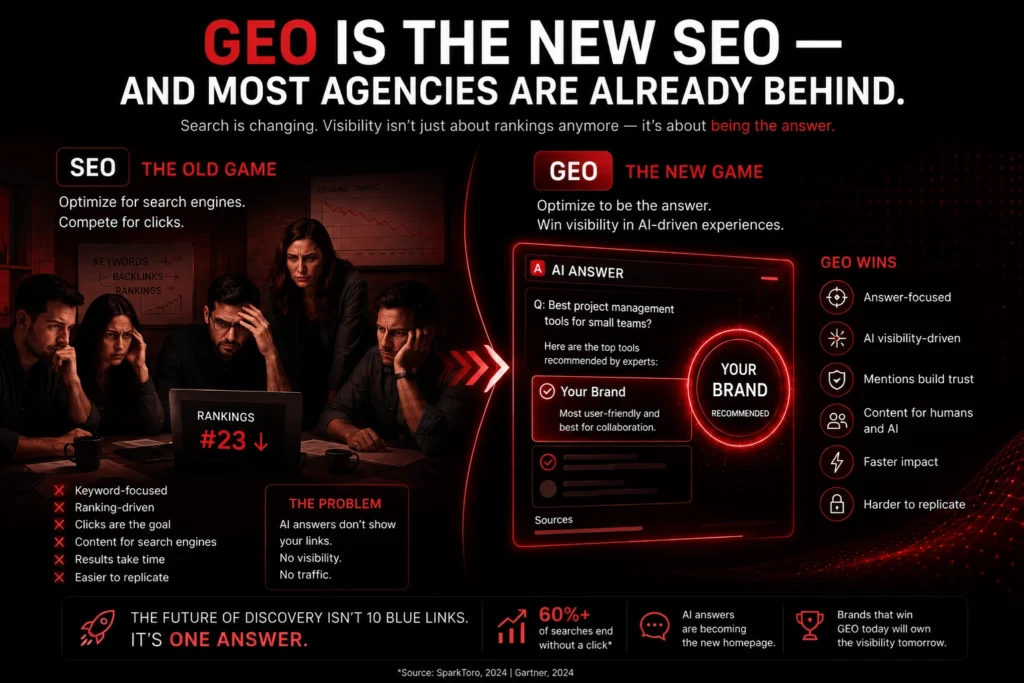
Over 50% of Google searches in 2025 ended without a single click, and that number is climbing fast as AI Overviews, ChatGPT, and Perplexity absorb the answers your website used to deliver. The old playbook of ranking #1 on Google is no longer enough. Enter generative engine optimization, the discipline of making your brand the source AI systems trust, cite, and recommend.
In this post, you’ll learn exactly what GEO is, how it differs from traditional SEO, what signals AI search engines actually use to surface content, and the concrete steps Indian businesses can take right now to show up where it matters in 2026.
What Is Generative Engine Optimization?
Generative engine optimization is the practice of structuring and positioning your content so that AI-powered search engines, not just Google’s blue links, discover, trust, and cite your brand in their responses.
What is Generative Engine Optimization: A content and authority-building strategy designed to make your brand visible and citable inside AI-generated answers on platforms like Google AI Overviews, ChatGPT, Perplexity, and Gemini.
GEO vs SEO: What Actually Changes
GEO and SEO share the same foundation: great content, strong authority, and clean technical structure, but the optimisation targets are fundamentally different.
Here’s where the two disciplines diverge:
- SEO targets: crawlers, keyword density, backlink graphs, page rank
- GEO targets: language model training data, retrieval-augmented generation (RAG) pipelines, entity recognition, citation patterns
- SEO measures: rankings, organic traffic, click-through rates
- GEO measures: AI citation frequency, brand mention share-of-voice in AI answers, zero-click impressions
- SEO content format: keyword-led, long-form, internally linked
- GEO content format: definition-first, answer-structured, stat-backed, schema-rich
The critical insight: GEO doesn’t replace SEO. It extends it. Your traditional SEO foundation, domain authority, technical health, and quality content still matter. But layering GEO signals on top is what gets you cited inside AI answers, not just ranked below them.
How AI Search Engines Decide What to Cite
AI search systems select sources based on a combination of authority signals, content structure, and semantic clarity, not just keyword match.
Entity Authority and Brand Recognition
Language models have a strong prior towards brands and entities they’ve encountered frequently in high-quality sources. If your brand appears consistently in trade publications, credible directories, and expert roundups, AI systems treat you as a trustworthy entity. This is why PR and digital authority building are now core GEO levers, not just nice-to-haves.
Content Structure and Directness
AI systems prefer content that answers questions directly and immediately. Paragraphs that bury the answer after three sentences of context get skipped. Sections that open with a clear, declarative statement get cited. This is the single biggest structural shift content teams need to make right now.
Statistical and Factual Density
Content that includes verifiable data, named sources, and specific figures is significantly more likely to be cited than opinion-led content. AI systems use factual grounding as a confidence signal. Every H2 section should include at least one citable data point.
Schema Markup and Structured Data
FAQ schema, HowTo schema, and Article schema help AI systems understand the structure and intent of your content, not just the text. If you’re not implementing structured data, you’re leaving a major GEO signal on the table.
A Real-World Example: How a SaaS Brand Won AI Citations
A B2B SaaS company in Bengaluru offering HR automation tools noticed that their organic traffic had plateaued despite ranking on page one for three primary keywords. In Q3 2025, they ran a GEO audit and found their content wasn’t being cited in any AI Overview results for their core category.
They made four targeted changes over 60 days:
- Rewrote H2 sections to open with direct, definitive answers instead of contextual preamble
- Added definition boxes to every pillar page for core industry terms
- Embedded statistics with named sources (Deloitte, NASSCOM, SHRM) in every major section
- Implemented FAQ schema across their top 20 pages, targeting “People Also Ask” queries
Within 90 days, their brand was cited in Google AI Overviews for six high-intent queries. Branded search volume increased 22%. And their sales team started reporting prospects who’d “heard of them from an AI search” before any paid touchpoint.
The 7 GEO Signals That Matter Most in 2026
Not all optimisation efforts carry equal weight in AI search. These are the signals with the highest citation impact right now.
1. Answer-First Content Architecture
Every section of your content should lead with its conclusion. State the answer, then explain it. AI systems extract the first clear statement from a section; if that statement is vague or hedged, it won’t get cited.
2. Definition Blocks for Key Terms
Format critical definitions as a bolded label followed by a single, clear sentence. This mirrors the format AI systems use in their own responses and makes extraction trivial. Think of it as leaving a perfectly shaped puzzle piece that slots directly into the AI’s answer.
3. Named Source Citations
Citing Gartner, McKinsey, NASSCOM, or sector-specific research bodies by name, with specific figures, radically increases your content’s credibility signal. Vague references to “studies show” provide no citation value.
4. Topical Authority Clustering
AI systems favour sources that demonstrate deep expertise across a topic cluster, not just a single article. If you have one strong blog post on GEO and nothing else around it, you’re a one-hit wonder in the model’s eyes. Build a content ecosystem: pillar pages, supporting articles, glossary entries, case studies.
5. E-E-A-T Signals Throughout
Experience, Expertise, Authoritativeness, and Trustworthiness aren’t just Google Quality Rater guidelines; they’re the proxy signals AI systems use to evaluate whether a source deserves citation. Author bios, credentials, first-person experience, and verifiable claims all contribute.
6. Conversational Query Alignment
People ask AI systems questions the way they’d ask a smart colleague, naturally, conversationally. Your content needs to reflect the actual language of those questions, not just keyword-matched phrases. AI search ranking is increasingly driven by semantic intent match, not keyword frequency.
7. Freshness and Update Frequency
AI systems prioritise recently updated content for fast-moving topics. A blog post from 2022 that hasn’t been touched is invisible in an AI Overview for a 2026 query. Build a content refresh cadence into your strategy, quarterly at minimum for pillar content.
What Indian Businesses Are Getting Wrong Right Now
Most Indian startups and agencies are still treating GEO as a future concern rather than a present priority, and that gap is already costing them visibility.
Here are the three most common mistakes we see:
- Publishing content optimised only for keywords: keyword density without an answer structure gets zero GEO traction
- Ignoring schema markup entirely: over 70% of Indian SME websites have no structured data implemented, according to a 2025 SEMrush India audit.
- Treating every blog post as a standalone: without topical clusters, you can’t build the authority depth AI systems need to trust you.
As a full-service SEO company in India, DigitalUltras has already integrated GEO frameworks into client content strategies because ranking in AI answers is where the next wave of organic growth is coming from.
How to Start Your GEO Strategy: A Step-by-Step Roadmap
Here’s a practical starting point for any Indian business owner or marketing manager ready to act.
- Run a GEO visibility audit: search your core keywords in Google (with AI Overviews enabled), ChatGPT, and Perplexity. Note which competitors are being cited. That’s your benchmark.
- Identify your top 10 pillar pages: these are the pages that should be winning citations. Rewrite their H2 openings to be direct, answer-first statements.
- Add definition blocks to every key term: one bolded label, one clear sentence. Do this for the five most important concepts on each pillar page.
- Embed named statistics: find one credible data point per major section and attribute it correctly. If you don’t have one, find one from NASSCOM, Gartner, Statista, or your industry association.
- Implement FAQ schema: take your five most common customer questions and add them to your top pages with proper FAQ structured data. This is one of the highest-ROI GEO actions available right now.
- Build your topical cluster: map out 8–12 supporting articles around each pillar topic and publish them consistently over the next quarter.
- Track AI citation share: use tools like Semrush’s AI Toolkit, Ahrefs, or manual tracking to monitor when and where your brand appears in AI-generated answers.
Frequently Asked Questions
Q: What is generative engine optimization, and why does it matter?
A: Generative engine optimization (GEO) is the practice of structuring your content so AI-powered search engines cite your brand in their generated answers. It matters because AI Overviews and tools like Perplexity are absorbing queries that used to drive organic traffic. If you’re not cited, you’re invisible to that audience.
Q: Is GEO replacing SEO completely?
A: No, GEO extends SEO; it doesn’t replace it. A strong SEO foundation (domain authority, technical health, quality content) is still essential. GEO adds a layer of optimisation specifically targeting how AI systems select and cite sources, which traditional SEO doesn’t address.
Q: How do I know if my content is being cited in AI search results?
A: Search your target keywords directly in Google (with AI Overviews on), ChatGPT, and Perplexity, and check which sources are cited. Tools like Semrush’s AI Toolkit and BrightEdge also offer AI visibility tracking. Manual monitoring is the fastest way to start benchmarking your position.
Q: How long does GEO take to show results?
A: Unlike traditional SEO, GEO can show measurable results within 60–90 days for well-structured content changes on pages with existing authority. New sites building from scratch should plan for a 4–6 month horizon before consistent AI citations appear.
Q: Which industries in India benefit most from GEO?
A: Any industry where prospects research before buying SaaS, fintech, edtech, healthcare, legal, and professional services sees the highest GEO ROI. If your customers ask questions online before making a decision, GEO is a direct channel to intercept that research at the zero-click moment.
Stay ahead in the evolving world of digital marketing with a free consultation from DigitalUltras.
