
Introduction: AI Is Eating Your Search Traffic — Here’s What to Do
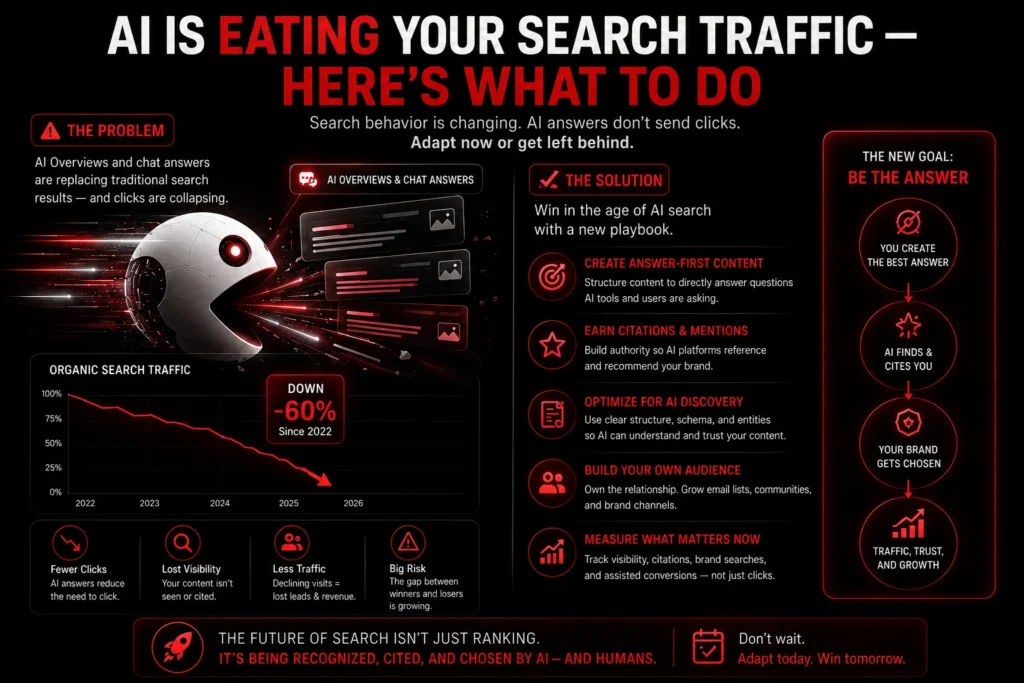
Organic search traffic dropped by an average of 34% for informational content after Google rolled out AI Overviews globally, according to a 2025 analysis by Search Engine Land. If your website’s traffic has been declining and your rankings haven’t changed, you’ve already felt this. The culprit is AI Overviews traffic loss, Google answering your audience’s questions before they ever reach your site.
What Is AI Overviews, Traffic Loss?
The decline in organic website visits caused by Google’s AI Overviews feature answering search queries directly in the results page, removing the click intent that traditionally drove traffic to ranked content.
This isn’t a ranking problem. Your page can sit at position one and still lose 60–70% of its historical clicks if an AI Overview sits above it. The query gets answered. The user leaves. Your analytics shows the drop, but your rank tracker doesn’t explain it.
Why This Is Worse Than the Featured Snippet Era
Featured snippets took clicks from result one. AI Overviews take clicks from the entire first page, and they synthesise answers from multiple sources, meaning no single site gets the traffic even when it’s being cited.
According to SparkToro’s 2025 zero-click study, 58.5% of Google searches in the US now end with zero clicks, and that figure is trending higher in markets where AI Overviews have fully rolled out. India is not far behind, with Google accelerating AI Overview deployment across Hindi and English searches through 2025 and into 2026.
Which Content Types Are Losing the Most Traffic
Not all content is equally exposed to AI Overview displacement, but the most commonly produced content types are the most vulnerable.
- How-to and tutorial content: AI Overviews summarise step-by-step instructions directly, eliminating the need to visit the source
- Definition and explainer posts: “What is X” queries are almost entirely absorbed by AI answers nowComparison content: “X vs Y” queries increasingly get synthesised AI responses citing multiple sources without sending traffic to any.
- FAQ and listicle pages: structured content that’s easy for AI to extract and repurpose into its own answers
- News and trend summaries: AI Overviews pull from multiple sources and present a unified summary, collapsing individual page visits.
A Real-World Example: An Indian SaaS Blog Loses 40% of Traffic Overnight
A B2B SaaS company in Hyderabad offering project management tools had built a content library of 180+ blog posts over three years. Their strategy was classic informational SEO: rank for high-volume how-to and explainer queries, drive traffic, convert through lead magnets.
Their response was a content pivot in three directions: converting top informational posts into original research pieces with proprietary data, building a comparison hub with actual product screenshots and user quotes (impossible for AI to replicate), and doubling down on transactional content targeting buyers, not researchers. Within four months, total organic traffic had recovered, and the traffic that remained converted at twice the rate of the informational traffic it replaced.
The Zero-Click SEO Reality and What It Means for Your Strategy
Zero-click SEO is no longer a future scenario;o it’s the current default for a large share of informational queries.
What is Zero-Click SEO: A search environment where users get their query answered directly on the results page through AI Overviews, featured snippets, or knowledge panels without clicking through to any website.
The strategic response isn’t to stop creating content. It’s to stop creating content whose only job is to answer a question that AI can now answer better and faster. Every piece of content you publish in 2026 needs a reason to exist, as AI can’t replicate original data, brand voice, product specificity, or a conversion goal.
What to Do About AI Overviews Traffic Loss: A Step-by-Step Recovery Plan
Here’s a practical, prioritised action plan for Indian business owners and marketing managers dealing with declining organic traffic right now.
- Run a traffic loss audit by content type. Pull your Google Search Console data and segment pages by query type: informational, navigational, commercial, transactional. Identify which informational pages have lost the most clicks in the last six months without a ranking drop. These are your AI Overview casualties.
- Identify your highest-exposure posts and repurpose them.Don’t delete them, transform them. Add original survey data, proprietary case studies, or first-person expert commentary that AI systems can’t generate. A post answering “how does email marketing work” becomes “how our clients’ email campaigns performed in Q1 2025: data from 40 campaigns.”
- Shift your content mix toward commercial and transactional intent.Queries like “best project management software for startups in India” and “how to choose a performance marketing agency” have purchase intent baked in. AI Overviews are less aggressive on commercial queries that users want to compare and decide, not just get an answer.
- Optimise to be cited inside AI Overviews, not just ranked below them.This is the GEO shift. Structure your content with direct-answer H2 openings, definition boxes, named statistics, and FAQ schema. If AI is going to answer your audience’s questions, make your brand the source it cites. Being credited in an AI Overview builds awareness even without a click.
- Build content that requires a click to deliver value.Interactive tools, original research reports, calculators, data visualisations, gated frameworks, these are formats AI cannot replicate because the value is in the interaction or the depth, not the summary. A “startup marketing budget calculator” delivers value only when the user engages with it directly.
For brands running paid acquisition alongside SEO, this recalibration is where a specialised partner adds real leverage. A performance marketing agency in Delhi that understands both organic and paid dynamics can bridge the gap between declining informational traffic and sustained lead volume without throwing budget at channels that haven’t been stress-tested for the current environment.
What Content Still Works in an AI-First Search World
The goal isn’t to fight AI search, it’s to build content that sits above or alongside it rather than beneath it.
Original Research and Proprietary Data
AI systems can summarise existing information. They can’t fabricate your survey results, your client data, or your internal benchmarks. Original research gets cited by AI, generates backlinks, and drives brand authority simultaneously. Even a small survey of 50 clients produces data that no AI can replicate.
Deeply Opinionated Expert Content
AI Overviews favour neutral, synthesised answers. Content that takes a strong, defensible position backed by experience and specific examples stands apart from what AI produces. Your point of view is a differentiation signal.
Product and Service Pages with Genuine Specificity
Transactional pages built around specific outcomes, named client results, and product-level detail are largely immune to AI Overview displacement. A well-built service page for “AI-powered lead generation for D2C brands in India” is not a query AI can fully answer without sending the user to you.
Community and User-Generated Content
Reviews, case studies, testimonials, and forum-style content carry social proof that AI cannot manufacture. Google’s own quality signals increasingly weigh authentic human experience, and AI Overviews are less likely to absorb content whose value comes from real user voices.
Frequently Asked Questions
Q: Why is my organic traffic dropping if my Google rankings haven’t changed?
A: Your rankings may be stable, but AI Overviews are answering your target queries before users reach your results. This is a classic AI Overviews traffic loss; the click never happens because the question gets resolved on the results page. Check Google Search Console for impressions-to-click ratio drops on your top pages.
Q: Which types of content are most affected by AI Overviews?
A: Informational content, such as how-to guides, definitions, explainers, comparisons, and FAQ posts, is most exposed. Transactional, product-specific, and brand-driven content is significantly less affected. Shifting your content mix toward commercial intent and original data reduces your exposure considerably.
Q: Can I get my content cited inside Google AI Overviews?
A: Yes. Structure your content with direct-answer openings for each section, include named statistics from credible sources, use FAQ schema markup, and add definition boxes for key terms. These structural signals make your content easier for AI systems to extract and cite, giving you brand visibility even in zero-click results.
Q: Is zero-click SEO the end of content marketing?
A: N, but it’s the end of content marketing that exists solely to answer questions AI can now answer. Content that drives clicks in 2026 must offer something AI can’t: original data, interactive tools, a strong brand perspective, or a direct path to a purchase decision. The volume game is over; the value game is what matters now.
Q: How long does it take to recover traffic lost to AI Overviews?
A: With a focused content pivot repurposing top-loss pages, shifting to commercial intent, and building citation-worthy structure, most brands see measurable recovery within 90 to 120 days. The traffic that returns is typically higher-intent than the informational traffic it replaces, which means better conversion rates on lower volume.
Want to stay ahead of AI-driven marketing? Book a free consultation with DigitalUltras.
