
Answer Engine Optimization Explained: The SEO Shift You Can’t Ignore
Over 65% of Google searches now end without a single click, according to DigitalApplied’s 2026 research; the answer shows up right on the results page, and the user never visits a website. That’s the entire reason answer engine optimization exists. In this post, you’ll learn exactly what it means, how AEO differs from traditional SEO, and the practical steps that improve your AI answer ranking across Google AI Overviews, ChatGPT, and Perplexity without needing a technical background to follow along.
What Is Answer Engine Optimization?
Answer engine optimization is the practice of structuring content so AI-powered platforms recognize it as trustworthy and cite it directly when generating answers to user questions.
Unlike ranking for a spot on page one, AEO aims for something more direct: getting your business named, quoted, or linked inside the actual answer a user reads. It applies across a growing list of surfaces: Google AI Overviews, ChatGPT, Perplexity, Gemini, Copilot, and even voice assistants like Siri and Alexa.
Why this matters right now:
- Traffic that arrives through AI citations converts roughly 4.4x better than traditional organic traffic, according to industry research compiled by DigitalApplied, because the user has already validated your content as credible before they click.
- A peer-reviewed study from Princeton, Georgia Tech, and IIT Delhi found that targeted optimization techniques can boost AI citation visibility by up to 40%, and in some cases by as much as 115%.
- 83% of AI citations for commercial and evaluation-stage queries come from pages updated within the past 12 months, per AirOps’ 2026 State of AI Search Report.
Put simply: AEO isn’t a nice-to-have add-on to your content strategy. It’s quickly becoming the strategy.
| Traditional SEO | Answer Engine Optimization (AEO) | |
| Goal | Rank in search results | Get cited inside AI answers |
| Success metric | Clicks and traffic | Citation frequency and trust |
| Content style | Keyword-focused | Answer-first, question-focused |
| Platforms targeted | ChatGPT, Perplexity, Gemini, AI Overviews | |
| Key win | Page 1 ranking | Direct mention or quote in the answer |
Where the Two Overlap
AEO isn’t a replacement for SEO; it’s built on top of it. AI platforms still need crawlable pages, clean site structure, and authoritative backlinks to trust and pull from your content in the first place. If your technical SEO is weak, no amount of AEO polish will save you.
Where They Diverge
Traditional SEO focuses on improving ranking positions, while Answer Engine Optimization (AEO) focuses on getting content cited directly within AI-generated answers. SEO typically measures success through clicks and website traffic, whereas AEO places greater emphasis on citation frequency, visibility, and trust. In terms of content style, SEO is often keyword-focused, while AEO prioritizes clear, direct, answer-first content built around user questions. SEO primarily targets traditional search engines such as Google, whereas AEO is designed to improve visibility across multiple answer engines, including ChatGPT and Perplexity. Understanding this difference helps explain why some pages may rank well in traditional search results but receive little or no visibility in AI-generated answers.
The Signals That Drive AI Answer Ranking
- Direct, extractable answers. The first sentence of a section should answer the question; models often pull exactly that sentence.
- Content freshness. More than 60% of AI-cited pages for commercial queries were refreshed within the last six months, per AirOps’ research.
- Domain authority. There’s a strong 0.65 correlation between domain authority and AI citation frequency, according to independent research by Jack Limebear.
- Structured data and clear entities. Consistent naming, schema markup, and unambiguous facts make it easier for models to verify what you’re saying.
- Original data. First-party statistics and benchmarks earn brand-specific citations that third-party numbers simply can’t, since AI engines cite the original source whenever possible.
A Mini Case Study: From Invisible to Cited
A Gurugram-based fintech client had strong Google rankings for their core comparison pages but zero visibility whenever we tested the same queries in ChatGPT and Perplexity. Their content buried the actual answer three paragraphs deep, under generic intros. We restructured their top ten pages using answer-first formatting: a direct one-sentence answer at the top of each section, a definition box for key terms, and one cited statistic per page instead of vague claims. Within six weeks, five of those ten pages started appearing as cited sources in Perplexity, and AI-referred traffic, though still a smaller slice than Google, converted at nearly triple the rate of their organic search traffic. That’s AEO working exactly as intended.
How to Start Doing Answer Engine Optimization Today
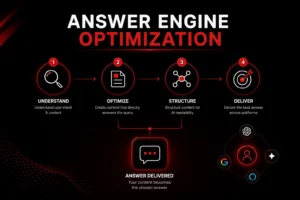
A Simple Starting Framework
- Audit your top pages against real AI queries. Ask ChatGPT and Perplexity the questions your customers ask, and see if you’re cited.
- Rewrite intros to lead with the answer. Cut the throat-clearing; state the direct answer in the first sentence.
- Add definition boxes for key terms. A clean, one-sentence definition is exactly what models look to extract.
- Refresh your highest-value pages regularly. Given how strongly freshness correlates with citation rates, treat your best pages as living documents, not one-time projects.
- Track citations, not just rankings. Add AI platform mentions to your reporting alongside traditional keyword positions.
Most teams stall out at step one because they’re still measuring success by rankings alone. The businesses actually pulling ahead treat answer engine optimization as a distinct, trackable channel, often paired with paid visibility work, which is why teams increasingly loop in a specialist PPC management company to make sure AI-driven traffic and paid campaigns aren’t working against each other.
Common Mistakes That Undermine Answer Engine Optimization
Treating It as a One-Time Project
AI citation patterns shift monthly as models retrain and re-crawl the web. Answer engine optimization needs the same ongoing attention as any other growth channel, not a single audit and a checklist.
Ignoring Technical SEO Fundamentals
No amount of clever formatting fixes a site AI models can’t crawl or trust. Answer engine optimization fails fast on top of weak technical foundations.
Copying Competitors’ Structure Without Original Data
AI engines increasingly favor first-party statistics and unique insight over recycled industry claims. If every page in your niche says the same thing, none of them stand out enough to get cited.
Frequently Asked Questions
Q1: What is answer engine optimization in simple terms?
A: Answer engine optimization is the practice of writing and structuring content so AI tools like ChatGPT, Perplexity, and Google AI Overviews choose to cite it directly in their answers, rather than just ranking it in a list of links.
Q2: Is AEO vs SEO an either-or choice?
A: No. Answer engine optimization builds on top of solid technical SEO — you still need crawlable pages and strong authority signals. Think of AEO as an additional layer focused on citations, not a replacement for existing SEO work.
Q3: How do I improve my AI answer ranking?
A: Lead each section with a direct, one-sentence answer, add clear definitions for key terms, cite real statistics with named sources, and keep your highest-value pages updated regularly, since freshness strongly correlates with citation frequency.
Q4: How long does answer engine optimization take to show results?
A: Some businesses see early citations within a few weeks of restructuring key pages, though building consistent AI visibility across multiple platforms typically takes a few months of ongoing refinement and fresh content.
Q5: Does answer engine optimization replace the need for backlinks?
A: No. Domain authority still correlates strongly with AI citation frequency, and backlinks remain a core signal of that authority. AEO adds structure and clarity on top of the authority you build through traditional SEO work.
Want to stay ahead of AI-driven marketing? Book a free consultation with DigitalUltras.
