
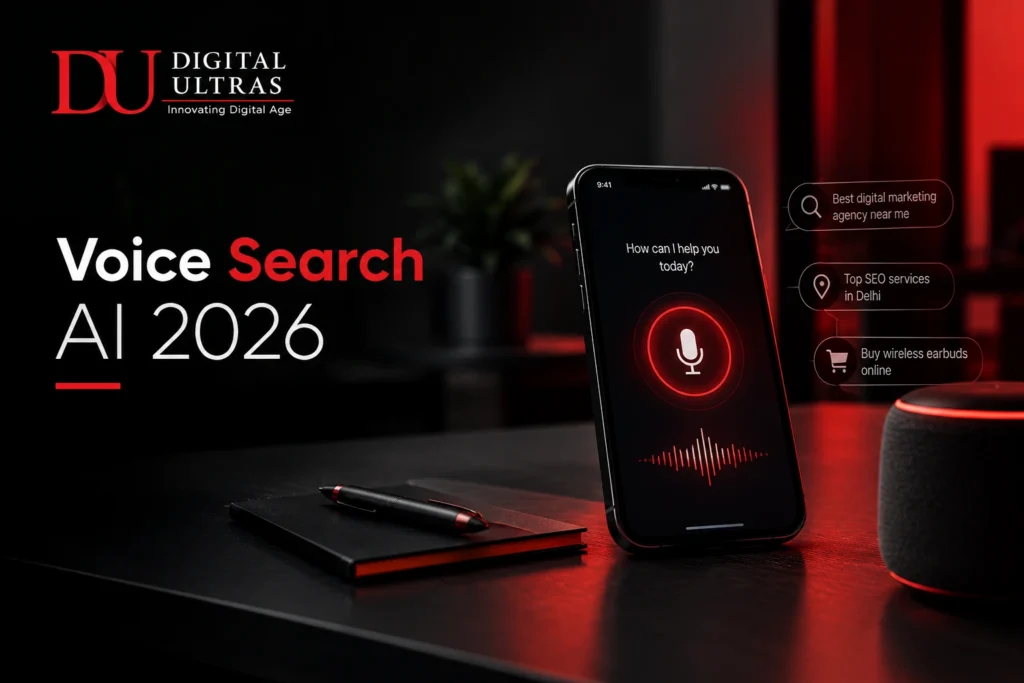
Voice Search Meets AI Assistants
Voice search is becoming more conversational, contextual, and closely connected with AI assistants, creating new opportunities for brands that understand how people search in 2026. The growth of voice search AI in 2026 is changing how users ask questions, discover businesses, compare products, and find solutions.
For marketers, this means traditional keyword optimization is no longer enough. Content needs to understand natural language, answer questions directly, and provide useful context that can work across search engines, AI assistants, and conversational interfaces.
What Is Voice Search AI 2026?
Voice search AI 2026 refers to the combination of voice-based search and artificial intelligence systems that understand spoken queries, interpret intent, and provide contextual answers.
Traditional search often involves short phrases such as “digital marketing agency Delhi.” A voice query may instead sound like, “Which digital marketing agency in Delhi can help my business generate leads?”
This difference is important because voice search AI 2026 focuses more heavily on intent, context, and natural language than simple keyword matching.
Why Voice Search AI 2026 Matters for Marketers
Voice search AI 2026 matters because users are increasingly able to express complex questions naturally instead of reducing their needs to a few keywords.
Google has also reported that AI Mode users are asking questions that are substantially longer and more complex than traditional searches. In India, Google introduced Search Live, which allows users to interact with Search through voice and camera in a conversational experience.
For marketers, these developments show why content should be written around real questions and customer intent.
How Voice Assistants Are Changing Marketing
Voice assistant marketing is becoming more important as AI assistants move beyond basic commands and become tools for research, recommendations, comparison, and decision-making.
A consumer might ask an assistant about a product, ask a follow-up question about its price, compare alternatives, and then ask where to purchase it. Each question can become part of the same conversational journey.
This makes voice search AI 2026 relevant across multiple stages of the customer funnel. Businesses need content that can answer initial questions as well as follow-up questions.
Voice Search AI 2026 and Conversational Search
Voice search AI 2026 is closely connected to conversational search because both allow people to communicate with search systems using natural language.
Google reported that AI Mode queries are currently around three times longer than traditional Search queries. This demonstrates how search is moving away from short keyword phrases toward more detailed questions.
For example, a traditional search might be “best PPC agency Delhi,” while a conversational query could be, “What should I look for when choosing a PPC agency in Delhi for a startup with a limited advertising budget?”
| Traditional Search | Voice and Conversational Search |
|---|---|
| Short keyword phrases | Complete natural-language questions |
| Keyword-focused | Intent-focused |
| One search at a time | Follow-up conversations |
| Limited context | More contextual understanding |
| Primarily text-based | Voice, text, image, and multimodal inputs |
| Search for links | Search for answers and actions |
The rise of voice search AI 2026 means marketers should consider how their content answers questions rather than simply where a keyword appears.
How AI Assistants Are Changing Customer Journeys
Voice search AI 2026 can influence customer journeys by helping people research, compare, and refine their decisions through conversational interactions.
Google’s 2026 research describes AI Search as becoming more multimodal, with people using text, voice, video, images, and other inputs to express what they need. Google also reports that the average AI Mode query is three times longer than a traditional Search query.
This creates a broader opportunity for marketers. A customer may begin with a general question and then progressively narrow their requirements.
How to Optimize Content for Voice Search AI 2026
Optimizing for voice search AI 2026 means creating clear, conversational, authoritative content that directly answers the questions users are likely to ask.
What is voice search optimization? Voice search optimization is the process of structuring digital content so search systems can understand and respond to natural-language queries effectively.
A practical content optimization process can be followed through these steps:
Step 1: Research the actual questions customers ask about your products, services, industry, and problems.
Step 2: Turn important questions into descriptive headings and provide a direct answer immediately below each heading.
Step 3: Use natural conversational language instead of repeatedly forcing exact-match keywords into sentences.
Step 4: Add supporting information such as examples, comparisons, definitions, locations, and practical explanations.
Step 5: Strengthen credibility through accurate information, relevant sources, clear expertise, and fact-checked claims.
Step 6: Review and update important pages regularly as search behavior and AI assistant capabilities continue to evolve.
This structure can help content perform across voice search AI 2026, traditional search, AI Overviews, and conversational search experiences.
What Type of Content Works for Voice Search?
Voice search AI 2026 works particularly well with content that gives direct answers while providing additional context for users who want to explore a topic further.
FAQ pages, service pages, how-to guides, comparison articles, local business pages, and educational content can all support conversational discovery.
The most important answer should appear early rather than being hidden behind several paragraphs of introduction. After the direct answer, the page can provide evidence, examples, explanations, and related questions.
| Content Type | Example Voice Query |
|---|---|
| FAQ | “What does a performance marketing agency do?” |
| How-to Guide | “How can I improve my Google Ads campaign?” |
| Local Content | “Which marketing agency is near me?” |
| Comparison | “What is the difference between SEO and PPC?” |
| Service Page | “What does a Meta Ads agency offer?” |
| Educational Article | “How does conversational search work?” |
The objective of voice search AI 2026 optimization is not to repeat a keyword unnecessarily. It is to make the content easy for both people and search systems to understand.
The Role of Local SEO in Voice Search AI 2026
Voice search AI 2026 is particularly relevant to local businesses because spoken queries often include immediate needs, locations, services, or nearby options.
People may ask questions such as “Where can I find a digital marketing agency near me?” or “Which restaurant is open nearby?”
Businesses should keep important local information accurate, including business name, location, services, contact information, operating hours, and other relevant details.
For local SEO, clear and consistent information helps search systems understand what a business offers and where it operates.
Voice Assistants Marketing Strategies for 2026
Voice assistants marketing should focus on providing useful answers instead of treating voice as simply another advertising placement.
Brands can develop conversational FAQs, question-focused articles, detailed service pages, local content, and helpful guides. These assets can support people whether they discover them through traditional search, voice assistants, or AI-powered search.
For voice search AI 2026, marketers should also consider follow-up questions. A person may ask one question and immediately ask another based on the response.
Creating content that anticipates those related questions can make the overall customer experience more complete.

The Future of Voice Search AI 2026
Voice search AI 2026 is becoming part of a wider shift toward conversational, multimodal, and AI-powered search experiences.
Google’s 2026 Search updates show this direction clearly, with AI Mode supporting voice, images, longer questions, and conversational follow-ups. Google also reported that AI Mode had surpassed one billion monthly active users globally by May 2026.
This means marketers should think beyond traditional voice SEO. Content needs to be useful across different interfaces while remaining clear, accurate, and focused on genuine user intent.
Conclusion
Voice search AI 2026 represents a shift from short keyword searches toward natural conversations between users and intelligent search systems.
The rise of voice assistants, marketing,g and conversational search means businesses need to understand how customers naturally ask questions and what information they need at every stage of their journey.
For Digital Ultras, the opportunity is to help businesses build content and marketing strategies that are ready for voice search AI 2026, AI-powered search, and the increasingly conversational way people discover information online.
