
OpenAI vs Google: The New AI Search War
ChatGPT now handles roughly 17% of all global digital queries, the first time in two decades anyone has cracked Google’s near-monopoly with a double-digit share. That single number sums up the AI search wars of 2026 better than any headline: this isn’t a hypothetical rivalry anymore; it’s a measurable shift in where people actually search. In this post, you’ll learn how OpenAI’s search engine is pulling query volume away from Google, how Google AI competition is responding through Gemini and AI Mode, and what this power struggle actually means for your business’s visibility in the months ahead.
What Are the AI Search Wars 2026?
Where OpenAI Is Pulling Ahead
- Session length. ChatGPT users average around 7.2 minutes per session, compared to roughly 4.5 minutes on rival platforms, according to Sedestral’s traffic analysis.
- Mobile-first adoption. An estimated 83% of AI usage now happens through mobile apps rather than browsers, per combined Graphite and Similarweb data a channel Google has to fight for, not assume.
- Subscriber momentum. OpenAI added more paying subscribers in January and February 2026 than in any prior two-month stretch in company history, crossing 50 million paid subscribers.
None of this means OpenAI’s search engine has “won.” It means the AI search wars of 2026 have created a second, genuinely competitive front that didn’t exist even eighteen months ago.
Google’s Three-Pronged Response
- AI Overviews inside classic search. Google keeps AI answers embedded in the results page users already trust, rather than asking them to switch apps.
- Gemini as a standalone assistant. Gemini’s jump to 750 million monthly active users shows Google AI competition isn’t just defensive; it’s genuinely gaining ground.
- AI Mode for complex queries. This gives Google a direct answer to ChatGPT’s conversational, multi-turn search style, built on top of an index no competitor can match.
The advantage Google still holds is distribution. Billions of people already open Google out of habit. Google AI competition doesn’t need to win new users, just keep the ones it already has from drifting away.
| Metric | OpenAI / ChatGPT | Perplexity | |
|---|---|---|---|
| Global search/query share | ~89.87% of traditional search (Sedestral, 2026) | ~17% of global digital queries (QuickSEO, 2026) | Smaller share, but fastest-growing AI-first engine |
| Active users | Billions via core Search; Gemini at 750M+ monthly active users (First Page Sage) | 900M weekly active users; 2.5B prompts/day (QuickSEO) | Smaller base, ~370% YoY growth (industry estimates) |
| Avg. session length | Shorter, query-and-click behavior | ~7.2 minutes per session (Sedestral) | Research-heavy, multi-turn sessions |
| Primary strength | Distribution and habit — AI Overviews embedded in existing search | Conversational, multi-step research queries | Transparent, numbered source citations |
| Year-over-year growth | Gemini share nearly doubled: 5.7% → 13.1% (First Page Sage) | Record subscriber growth Jan–Feb 2026, 50M+ paid subs | ~370% YoY traffic growth |
| Mobile-first usage | Strong but app-fragmented | ~83% of AI usage now happens on mobile apps (Graphite/Similarweb) | Growing mobile adoption |
A Mini Case Study: What This Means for a Real Business
A Gurugram-based B2B consulting client came to us worried their inbound leads had dropped nearly 20% quarter-over-quarter, even though their Google rankings hadn’t changed. When we pulled their AI referral data, ChatGPT and Perplexity combined had overtaken direct Google organic traffic as their top research-stage source. Their site simply wasn’t structured to get cited in AI answers; clear definitions, direct answers, and cited stats were missing. Once we rebuilt their core pages around those elements, AI-driven referral traffic grew 40% within two months, and it converted at a noticeably higher rate than their old organic traffic. That’s the practical reality of the AI search wars 2026: your Google ranking can stay flat while your actual visibility quietly shifts elsewhere.
How to Prepare Your Business for the AI Search Wars 2026
What is AI search readiness:
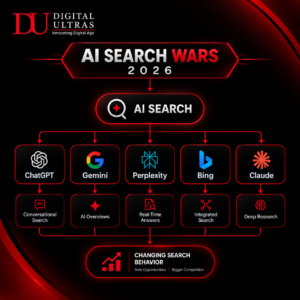
AI search readiness means structuring your content and digital presence so it can be found, trusted, and cited across Google, ChatGPT, Perplexity, and any AI platform your customers actually use.
A Practical Checklist
- Stop treating Google as the only channel. Track referral traffic from ChatGPT, Perplexity, and Gemini separately in your analytics.
- Structure content for extraction. Clear headings, direct answers, and short paragraphs help every AI platform pull your content into its answers.
- Diversify where you earn mentions. Press coverage, guest content, and third-party citations feed every AI model, not just Google’s index.
- Watch session behavior, not just rankings. A flat ranking can hide a real drop in visibility if AI platforms have quietly become your customers’ first stop.
Businesses that treat this as a one-time audit will fall behind fast. The AI search wars of 2026 are moving month to month, not year to year, and your strategy needs to move at the same pace, which is exactly the kind of ongoing work a specialist lead generation company Delhi businesses trust can help you stay on top of without pulling your team away from day-to-day operations.
The Honest Scorecard
- Google wins on raw market share and ad revenue, still controlling the vast majority of total search volume.
- OpenAI wins on growth velocity, session length, and mobile-first habit formation among younger, research-heavy users.
- Perplexity, though far smaller, posted roughly 370% year-over-year growth by positioning itself purely as an AI-first search engine rather than a general chatbot.
The real answer is that the AI search wars of 2026 aren’t a single contest with one winner; rather, they’re multiple overlapping battles for different types of queries, and your business needs a presence in more than one of them.
Frequently Asked Questions
Q1: Is ChatGPT actually replacing Google search?
A: Not entirely. Google still controls roughly 90% of the traditional search market, but ChatGPT has captured a meaningful share of research and multi-step queries. The two platforms are increasingly competing for different types of search intent rather than the same searches.
Q2: What is OpenAI’s search engine actually good at?
A: OpenAI’s search engine excels at multi-step, conversational research where users need a synthesized answer rather than a list of links. It’s especially strong for comparison shopping, learning, and planning-style queries that used to require several separate Google searches.
Q3: How is Google responding to AI search competition?
A: Google AI competition centers on AI Overviews embedded directly in search results, plus standalone tools like Gemini and AI Mode. Google’s advantage is existing user habit and distribution; n it doesn’t need new users, just retention of the ones it already has.
Q4: Should small businesses worry about the AI search wars in 2026?
A: Yes, especially informational and research-stage content. Even if your Google rankings look stable, AI referral traffic from ChatGPT and Perplexity may already be reshaping where your customers discover you first.
Q5: Which platform should businesses prioritize: Google or ChatGPT?
A: Neither exclusively. The safest strategy is structuring content so it performs well across both, since Google still drives the most total volume while ChatGPT and Perplexity are growing the fastest among research-heavy buyers.
Want to stay ahead of AI-driven marketing? Book a free consultation with DigitalUltras.
