
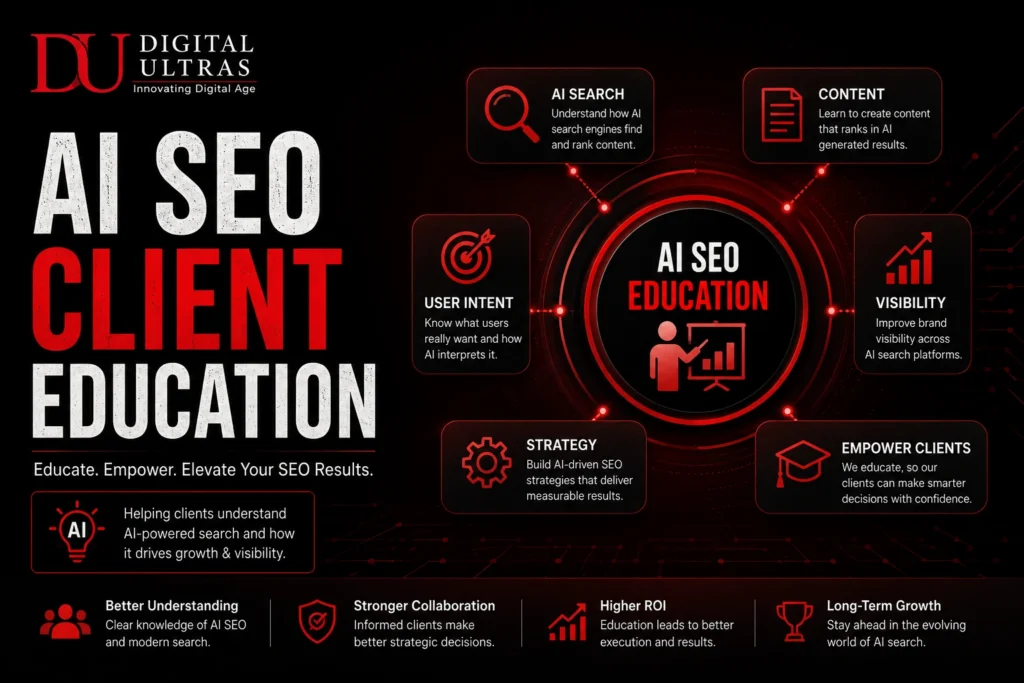
Why Clients Are Asking About AI SEO (And What Your Agency Needs to Say)
Only 10% of marketing leaders are satisfied with their agency’s ability to execute on AI, even though 54% say AI readiness is a top factor in choosing one, according to Forrester’s 2026 B2B survey. That gap is exactly why AI SEO client education has become one of the most valuable skills an agency can offer. In this post, you’ll learn why clients are suddenly asking about AI SEO, how to explain it without jargon, and the exact framework we use at DigitalUltras to turn confused prospects into confident, retained clients.
Why AI SEO Client Education Matters Right Now
Clients are asking about AI SEO because they’ve seen it mentioned everywhere and understood almost none of it. Good AI SEO client education fills that gap before a competitor does.
Here’s the reality on the ground:
- 65% of marketers cite AI-driven search changes as their single biggest challenge this year, according to GoodFirms’ 2026 survey of digital marketing practitioners.
- 35% of businesses are still unaware that AI can even be used for content and SEO, per DemandSage’s 2026 data a knowledge gap your agency can close.
- 81% of marketers still say “SEO” internally instead of “GEO” or other buzzwords, per Fractl’s July 2026 study, proving that jargon-heavy pitches actually lose deals.
That last stat matters more than most agencies realize. AI SEO client education only works if you ditch the acronyms and explain outcomes in plain language.
What Clients Actually Want to Know
What is AI SEO: AI SEO is the practice of optimizing content and digital presence so it gets found, understood, and cited by AI-powered search tools like Google AI Overviews, ChatGPT, and Perplexity, not just ranked in traditional blue links.
The Three Questions Every Client Asks
- “Is my website even showing up in AI answers?” Most clients have never checked, and most agencies haven’t shown them how.
- “Do I still need regular SEO?” Yes, and explaining why is a core part of AI SEO client education, since AI tools still pull from crawlable, authoritative web content.
- “How do I know this is working?” Clients want proof, not promises, which means reporting needs to evolve alongside the strategy.
If you can answer these three questions clearly, you’ve done more AI SEO client education in five minutes than most competitors do in a full pitch deck.
How to Talk About Selling AI SEO Services Without Sounding Like a Sales Pitch
Selling AI SEO services works best when you lead with a diagnosis, not a pitch. Show the client where they stand before you tell them what to buy.
A Mini Case Study: The Confused SaaS Founder
A Gurugram-based SaaS founder came to us convinced he needed “GEO” because a LinkedIn post told him so. Instead of selling him a package, we ran a quick audit showing he wasn’t appearing in ChatGPT or Perplexity answers for his core product category, while two competitors were. That single side-by-side comparison did more for AI SEO client education than any slide deck could. He signed within a week not because we used the right buzzword, but because we showed him the gap in his own numbers.
What Works When Selling AI SEO Services
- Show, don’t tell:l pull real screenshots of AI answers that mention (or ignore) the client’s brand.
- Translate technical concepts into business outcomes: citations mean trust, trust means conversions.
- Avoid stacking acronyms like GEO, AEO, and LLMO in the same sentence; pick one term and stay consistent.
- Tie every recommendation back to revenue, not rankings.
Agency AI Positioning: How to Stand Out From Competitors
Agency AI positioning works best when it’s backed by visible proof, not just claims of expertise. Every agency now says it “does AI SEO,” but few can show what that actually means in practice.
Building Credible Agency AI Positioning
- Publish real case studies showing before-and-after AI citation results, not just traffic graphs.
- Create a simple AI visibility audit you can run for any prospect in under 15 minutes.
- Train your account managers to explain AI SEO in one paragraph, without slides.
- Publish original data and commentary so your own agency gets cited as a source, proof you can walk the talk.
Strong agency AI positioning isn’t about claiming to be first. It’s about being the clearest voice in a market full of confusing acronyms, which is a big part of why working with a full-service performance marketing agency Delhi businesses trust has become a real differentiator instead of just a location tag.
Building an AI SEO Client Education Process Into Your Onboarding
The best time for AI SEO client education is before the contract is signed, not after a client asks why traffic looks different this quarter.
A Simple Onboarding Framework
- Audit first. Show the client exactly where they appear (or don’t) across Google, ChatGPT, and Perplexity.
- Set expectations early. Explain that AI citations shift monthly and that consistency matters more than one-off wins.
- Define shared language. Agree on which terms SEO, AI SEO, GEO you’ll actually use in reporting.
- Share a simple glossary. A one-page explainer prevents repeated confusion later in the relationship.
Agencies that build AI SEO client education into onboarding see fewer confused check-in calls and higher retention, because clients understand what they’re paying for from day one.
Common Mistakes Agencies Make With AI SEO Client Education
Overloading Clients With Jargon
Terms like GEO, AEO, and LLMO mean nothing to a business owner focused on revenue. Translate every acronym into a plain-English outcome before you use it twice.
Promising Guaranteed AI Citations
No agency can guarantee a specific citation in ChatGPT or Google AI Overviews. Citation sets change roughly every month, so honest AI SEO client education always includes that variability upfront.
Skipping the “Why” Behind Recommendations
Clients who don’t understand why a tactic matters won’t approve the budget for it. Every recommendation needs a one-sentence business reason attached.
Frequently Asked Questions
Q: What is AI SEO client education?
A: It’s the process of helping clients understand how AI-powered search tools work, why traditional rankings alone aren’t enough anymore, and what steps actually improve visibility in AI Overviews, ChatGPT, and Perplexity.
Q: How do agencies start selling AI SEO services to skeptical clients?
A: Start with a free audit showing where the client currently appears in AI search results. Real data builds more trust than any pitch deck, and it naturally opens the conversation about strategy and pricing.
Q: What’s the difference between SEO and AI SEO?
A: Traditional SEO focuses on ranking pages in search results. AI SEO focuses on getting content cited directly inside AI-generated answers, which requires clearer structure, stronger sourcing, and third-party credibility.
Q: Why do clients confuse GEO, AEO, and AI SEO?
A: The industry hasn’t settled on one term, and most marketers still default to “SEO” in daily conversation. Good AI SEO client education picks one consistent term and avoids stacking multiple acronyms in the same pitch.
Q: Does agency AI positioning actually influence client decisions?
A: Yes. Clients increasingly choose agencies based on demonstrated AI readiness, not just past campaign results. Clear agency AI positioning, backed by real case studies, has become a genuine competitive advantage in 2026.
Clients aren’t asking about AI SEO because it’s a trend; they’re asking. After all, they’ve noticed the search landscape shifting under them. Agencies that invest in real AI SEO client education, backed by clear positioning and honest reporting, will win the retainers that confused, jargon-heavy competitors lose.
Want to stay ahead of AI-driven marketing? Book a free consultation with DigitalUltras.
