

Physical AI Robots + LLMs: The Quiet Revolution Reshaping Business in 2026
Physical AI robots powered by LLMs are no longer a science fiction concept; they’re on factory floors right now. According to the International Federation of Robotics 2025 Report, global installations of AI-integrated robots grew 43% year-over-year, with the manufacturing and logistics sectors leading adoption. If you think this only affects large multinationals, think again. Indian SMEs in automotive, pharma, textiles, and warehousing are already being disrupted by competitors deploying physical AI robots and LLMs to cut costs and scale output.
This post breaks down exactly what physical AI is, how LLMs are transforming robots from mechanical arms into intelligent collaborators, which industries are feeling it first, and what Indian businesses need to know right now.
What Are Physical AI Robots Powered by LLMs?
Physical AI robots powered by LLMs are robotic systems that use large language models as their reasoning and decision-making brain, enabling them to understand instructions, interpret environments, and adapt to unpredictable real-world conditions without being pre-programmed for every scenario.
Robots that combine physical actuators and sensors with large language model intelligence, allowing them to receive natural language instructions, reason about their environment, and execute complex, multi-step physical tasks autonomously.
Here’s what makes this different from traditional industrial robots:
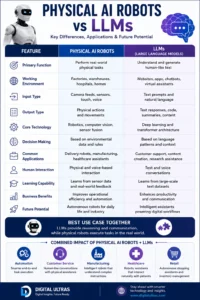
- Traditional robots: pre-programmed, rigid, break when conditions change, require expert reprogramming
- Physical AI robots LLMs: adaptable, instruction-following, handles novel situations, learns from corrections
- Key capability shift: you can tell an LLM-powered robot “sort the defective units from this batch” in plain language, no code required
- Result: dramatically lower deployment barriers for non-technical manufacturing and operations teams
How LLMs Are Transforming Physical AI Robots
LLMs transform physical AI robots from single-task machines into general-purpose intelligent systems that can be redirected through language rather than reprogrammed through code.
The integration works through three layers:
- Perception layer: cameras, lidar, and tactile sensors feed real-world data to the LLM, the robot “sees” and “feels” its environment
- Reasoning layer: the LLM interprets sensor data, understands the task context, and plans the sequence of physical actions needed
- Action layer: the robot’s motors and actuators execute the plan, picking, sorting, assembling, and navigating with the LLM adjusting in real time based on what the sensors report back
What this means practically for a factory floor manager:
- Reassign a robot to a new task by describing it in plain Hindi or English, with no downtime for reprogramming
- Robots flag anomalies and ask clarifying questions when they encounter an ambiguous situation
- A single robot handles multiple task types across a shift instead of being locked to one station
- Continuous improvement, the system learns from corrections and edge cases over time
Industries Being Transformed by Physical AI Robots and LLMs in India
Physical AI robots and LLMs are hitting five Indian industry verticals hardest in 2026, and the pace of adoption is accelerating.
Manufacturing
- Quality inspection: AI-powered vision robots detect defects at micron precision — 200x faster than manual inspection
- Assembly: LLM-guided arms adapt to product variation without line reconfiguration
- Maintenance prediction: robots monitor their own wear and schedule maintenance autonomously
- Indian context: Tata, Mahindra, and mid-sized auto ancillary suppliers are already piloting these systems in Pune and Chennai plants
Logistics and Warehousing
- Order picking: LLM-powered robots read natural language picklists and navigate dynamic warehouse layouts
- Last-mile: autonomous delivery robots navigating unstructured Indian urban environments using LLM spatial reasoning
- Returns processing: AI robots assess return condition, sort by category, and update inventory systems all autonomously
Agriculture
- Crop monitoring: drone robots with LLM vision identify disease, pest damage, and irrigation needs at the field scale
- Harvesting: physical AI robots adapting pick patterns to irregular crop geometry previously impossible for rigid systems
Healthcare
- Surgical assistance: LLM-powered robotic arms interpreting surgeon instructions in real time
- Pharmacy automation: dispensing robots understanding and verifying prescription language autonomously
Retail and E-Commerce
- In-store navigation robots that answer customer questions using natural language and escort shoppers to products
- Fulfilment centres where LLM-powered systems handle unstructured product shapes that defeat traditional automation
A Bengaluru-based e-commerce fulfilment company deployed an LLM-integrated picking robot system in Q3 2025 to handle their SKU catalogue of 80,000+ products, a scale that made traditional barcode-guided automation impractical.
The results after 90 days:
- Picking accuracy: 99.2% versus 94.7% with manual pickers driven by LLM-powered visual verification at each pick
- Throughput: 340 picks per hour per robot versus 110 picks per hour per human picker
- Onboarding new SKUs: reduced from a 3-day manual cataloguing process to a 4-hour AI ingestion workflow
- Breakeven: capital cost recovered in 14 months at current operational savings
The key differentiator wasn’t the robot hardware; it was the LLM layer that allowed the system to handle novel products, damaged packaging, and ambiguous placement instructions without stopping the line. Physical AI robots and LLMs made the difference between a system that broke at the edges and one that adapted to them.
As physical AI and robot integration reshape operational efficiency across industries, the marketing and growth strategies supporting these businesses need to evolve at the same pace. A digital marketing company in India that understands AI-native business operations can help brands in manufacturing, logistics, and D2C position themselves for the buyers, investors, and partners that the physical AI era is creating.
What Indian Businesses Should Do Right Now
Physical AI robots and LLMs are not a five-year horizon. Here’s where to focus immediately:
- Audit your highest-cost manual processesIdentify repetitive physical tasks currently done by humans that have a clear input/output structure (sorting, inspection, picking, packing)
- Calculate your true cost of manual errordefect rates, rework costs, and process downtime are your ROI baseline for physical AI investment
- Evaluate existing automation vendors for LLM integration roadmapsIf your current robotics supplier isn’t integrating LLMs, your system will be obsolete within 24 months
- Start with a single process pilotPick one high-frequency, high-error-rate physical task and run a 60-day pilot before committing to full deployment
- Build internal AI literacy in your operations teamThe bottleneck to deploying physical AI robots and LLMs in most Indian SMEs is change management, not technology access
- Connect with government incentive programsPLI schemes and NASSCOM’s AI adoption programs provide subsidies for qualifying Indian manufacturers deploying AI-integrated robotics
Unlock smarter marketing opportunities for your business. Claim your free consultation with DigitalUltras today.
