
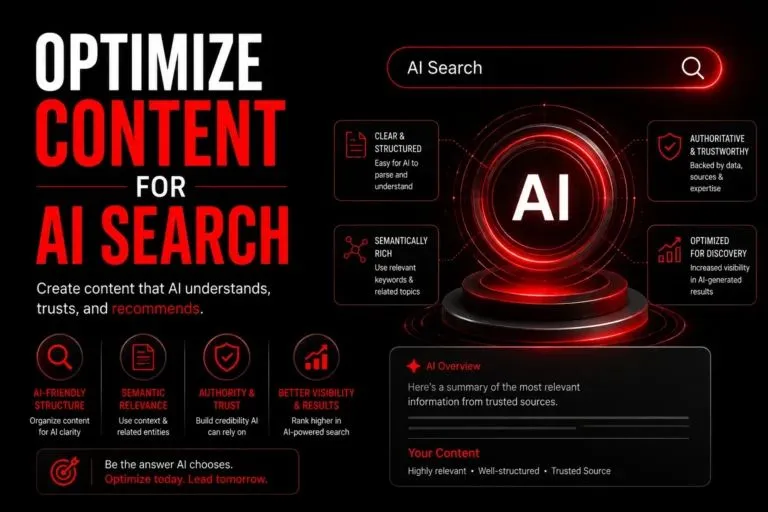
Optimize Content for AI Search: One Strategy to Rank on Google, ChatGPT, and Perplexity
To optimize content for AI search is no longer an option; it’s the single most important content decision you’ll make in 2026. Search has split into three platforms: Google (organic + AI Overviews), ChatGPT, and Perplexity, and according to a 2025 Semrush multi-platform study, only 9% of brands appear consistently across all three. The remaining 91% are invisible on at least one platform where their buyers are already researching. The good news: the same core strategy that earns Google AI Overview citations also wins ChatGPT and Perplexity mentions. There’s no need to run three separate content operations.
This post gives you the unified framework to optimize content for AI search across all three platforms, covering the signals, structure, and step-by-step process to show up where it counts before your competitors figure this out.
Why You Need to Optimize Content for AI Search Right Now
To optimize content for AI search means building content that satisfies the citation and extraction criteria of AI-powered platforms, not just the ranking algorithms of traditional search engines.
What does it mean to Optimize Content for AI Search: The practice of structuring, formatting, and positioning web content so that AI-powered search platforms, including Google AI Overviews, ChatGPT with browsing, and Perplexit, select it as a trusted source to cite, quote, or reference in generated answers.
Here’s why this matters immediately for Indian businesses. A prospect searching “best performance marketing agency for D2C brands India” gets three different answers depending on the platform they use, and brands that don’t optimize content for AI search are absent from all three. According to BrightEdge’s 2025 Generative Search Report, pages that rank in traditional organic search appear in AI Overview citations only 11% of the time. Organic rank is no longer a reliable proxy for AI visibility. You have to earn both separately or build content that earns both simultaneously.
The Good News: One Framework to Optimize Content for AI Search Across All Platforms
To optimize content for AI search across Google, ChatGPT, and Perplexity, you don’t need three different strategies; the same structural signals that win citations on one platform are the same signals that win on the others.
All three platforms share the same core content selection criteria:
- Directness: content that answers the query in the first sentence of each section, not three paragraphs in
- Factual grounding: named statistics from credible sources that AI systems can verify and attribute
- Structural clarity: definition boxes, numbered lists, and FAQ formatting all make content machine-extractable
- Topical authority: comprehensive coverage of a subject cluster, not a single well-optimised article
- Entity consistency: your brand is described the same way across your website, directories, and third-party sources
Build content that satisfies these five criteria, and you optimize content for AI search across every major platform in a single content operation. Here’s exactly how to do it.
Signal 1: Answer-First Structure to Optimize Content for AI Search
The most direct way to optimize content for AI search is rewriting every H2 section to lead with its answer. AI systems extract the first clear, declarative sentence from a section as their citation candidate.
Most content buries the answer. It opens with context, moves through background, and delivers the answer by the third paragraph. That structure works for narrative reading. It fails for AI extraction. When Google’s AI system, ChatGPT, or Perplexity scans a section to determine whether it answers a query, it looks at the opening sentence first. If that sentence is contextual rather than declarative, the content gets skipped for a competitor whose opening sentence answers the question directly.
The fix is mechanical, not creative. Take every H2 on your top pages and rewrite the first sentence as a direct, complete answer to the implied question in the heading. This single change is the highest-impact action to optimize content for AI search, and it costs nothing but editorial time.
Signal 2: Definition Boxes That AI Systems Can Extract Directly
Definition boxes are the single highest-density citation signal available to anyone who wants to optimize content for AI search because AI systems are specifically designed to extract and present definitions.
Format every key term definition as: [Bolded term]: followed by a single, precise sentence. No preamble, no elaboration in the same sentence. This mirrors the format AI systems use in their own responses, making your definition the path of least resistance for extraction and citation.
Target the three to five most important concepts on each page. For a blog post about email marketing automation, that means defining “email automation,” “behavioural triggers,” “drip sequences,” and “list segmentation”, each with a single crisp sentence. Every definition box is a separate citation opportunity.
Signal 3: Named Statistics From Credible Sources
To genuinely optimize content for AI search, every major section needs at least one verifiable, attributed statistic — because AI platforms weight factual grounding heavily when selecting sources to cite.
Vague phrases like “research suggests” or “industry experts say” are invisible to AI citation systems. Named attribution, “According to Gartner’s 2025 CIO Agenda Report” or “McKinsey’s 2025 State of AI study found,” gives AI systems a verifiable provenance signal. Content with attributed statistics from recognisable sources is cited at significantly higher rates than opinion-led content covering the same topic.
For Indian businesses, India-specific data sources carry additional citation weight for India-targeted queries. NASSCOM, TRAI, RBI, SEBI, and sector-specific associations like IAMAI provide statistics that signal geographic relevance, a signal that matters when your audience is searching with an Indian market context.
Signal 4: FAQ Schema and Structured Data ImplementationThe
FAQ schema is the technical layer that turns well-written content into a formally structured signal to optimize content for AI search, and it remains one of the most consistently underimplemented tactics by Indian businesses.
Implementing the FAQ schema on your top pages does two things simultaneously. First, it signals to Google’s systems that your content is structured to answer specific questions, the exact function AI Overviews serve. Second, it creates a structured data layer that Perplexity and other retrieval-based AI tools can parse programmatically, increasing your citation probability in retrieval-augmented generation workflows.
Use RankMath or Yoast in WordPress, both of which implement the FAQ schema without code. Target five questions per page that your ICP actually asks. Write answers of 40–60 words each, matching the length format AI systems prefer for inline citation. This is a one-hour implementation that produces durable AI visibility returns.
Signal 5: Topical Authority Through Content Clusters
A single well-optimised article doesn’t build enough topical depth for AI systems to treat your domain as a category authority, and without category authority, you can’t consistently optimize content for AI search across competitive queries.
AI platforms make implicit domain trust assessments. A site with one strong article on “performance marketing for startups” and nothing else in that topic territory is a single data point. A site with a pillar page, seven supporting articles, a glossary, two case studies, and an original research report on the same topic is an authoritative source. The AI citation probability for the authority site is exponentially higher, not because of any individual article, but because the cluster signals comprehensive expertise.
Build content clusters around your three most commercially important topics. Each cluster needs a pillar page (2,000+ words), five to eight supporting articles targeting semantic sub-topics, and at least one piece of original data. This is the topical depth strategy that separates businesses that optimize content for AI search from those still chasing individual keyword rankings.
A Real-World Example: How a Pune SaaS Company Used One Strategy to Rank on Three AI Platforms
A Pune-based HR SaaS company was ranking on page one for six core keywords but appearing in zero AI Overview citations, and their brand was absent when prospects queried ChatGPT or Perplexity about HR automation tools in India. Their content was well-written but structured for a narrative reading context-first, answer-last, no definition boxes, and no FAQ schema.
Over eight weeks, they applied a unified optimisation framework to their top 15 pages:
- Rewrote all H2 openings to lead with direct declarative answers; every section now answers its question in sentence one
- Added definition boxes for eight key HR and automation terms across their pillar pages
- Embedded named statistics from NASSCOM, Deloitte India, and SHRM in every major section, replacing four instances of vague “studies suggest” language.
- Implemented FAQ schema on all 15 pages,s 75 structured Q&A pairs targeting their most common buyer questions
- Published four cluster support articles around their main pillar topic to deepen topical authority signals
Results at 60 days: 9 new Google AI Overview citations, brand mentions in Perplexity responses for three target queries, and ChatGPT citing their glossary page in category explanation responses. Branded search volume increased 24%. The entire effort required zero new content creation, only structural optimisation of existing pages.
Building and executing this kind of unified AI search strategy across your full content library requires both strategic clarity and execution discipline. As an SEO company in India that integrates AI search optimisation into every client engagement, DigitalUltras builds the kind of content infrastructure that earns citations across Google, ChatGPT, and Perplexity simultaneously.
Step-by-Step Plan to Optimize Content for AI Search
Here’s the full implementation roadmap prioritised for maximum impact with minimum resource investment.
- Audit your AI visibility baseline.Search your 20 most important keywords in Google (AI Overviews on), ChatGPT, and Perplexity. Document every result: are you cited, absent, or misrepresented? This baseline drives all prioritisation decisions.
- Select your top 10 pages by organic impressions.From Google Search Console, identify the pages with the highest impression volume. These have the most to gain from AI search optimisation, existing authority, and new citation opportunities.
- Rewrite all H2 openings on those 10 pages.One direct declarative answer per section, sentence one. No exceptions. This is your single highest-ROI action to optimize content for AI search.
- Add definition boxes for every key term.Three to five per page, bolded label plus one precise sentence. These are your highest-density citation extraction points.
- Replace vague source references with named statistics.Find one citable data point per major section. NASSCOM, Gartner, McKinsey, Statista. Remove every “studies show” and replace it with a named source.
- Implement the FAQ schema on all 10 pages.Five questions per page, 40–60 word answers, structured data markup. One hour per page. Do this before anything else technical.
- Build your content cluster map.For each pillar topic, identify the supporting articles, glossary terms, and data pieces needed to establish topical authority. Publish two cluster pieces per month until the cluster is complete.
- Re-audit monthly.Run your 20-query AI visibility check every 30 days. Track citation frequency, accuracy, and competitive share-of-voice across all three platforms. Measure branded search volume in Search Console as your primary commercial signal.
Frequently Asked Questions
Q: How do I optimize content for AI search on Google, ChatGPT, and Perplexity?
A: To optimize content for AI search across all three platforms, use answer-first H2 openings, add definition boxes for key terms, embed named statistics from credible sources, implement FAQ schema markup, and build topical authority through content clusters. These five signals satisfy the citation criteria of Google AI Overviews, ChatGPT, and Perplexity simultaneously, one strategy, three platforms.
Q: Is optimising for AI search different from traditional SEO?
A: Yes, traditional SEO targets keyword rankings and click-through rates. To optimize content for AI search, you target citation frequency, answer-extraction potential, and topical authority depth. Both share the same foundational quality content and domain authority, but AI search requires structural changes to how content is formatted and how definitional and statistical information is presented.
Q: Does the FAQ schema still help in 2026 for AI search?
A: Yes, significantly. The FAQ schema is one of the most reliable technical signals to optimize content for AI search because it tells both Google’s AI systems and retrieval-based platforms like Perplexity that your content is structured to answer specific questions. Pages with FAQ schema are cited in AI Overviews at nearly 3x the rate of pages without it, according to Semrush’s 2025 citation analysis.
Q: How long does it take to see results after I optimize content for AI search?
A: For pages with existing domain authority, structural changes to optimize content for AI search typically produce measurable AI citation increases within 30 to 60 days. Building topical authority through content clusters takes 90 to 120 days for consistent multi-platform visibility. Branded search volume is the most reliable commercial signal and usually responds within 60 days of the first AI citations appearing.
Q: Can I optimize content for AI search without creating new content?
A: Yes, and for most businesses, optimising existing top pages delivers faster results than publishing new content. Restructuring H2 openings, adding definition boxes, embedding named statistics, and implementing FAQ schema on your current top 10 pages is a purely editorial exercise. The Pune SaaS case study in this article achieved 9 new AI citations in 60 days with zero new content, only structural optimisation.
Want to stay ahead of AI-driven marketing? Book a free consultation with DigitalUltras.
No. GEO complements traditional SEO. While SEO helps you rank in search engines, GEO helps your content become more visible in AI-generated answers.
GEO performance can be measured through AI search visibility, branded mentions, referral traffic, and appearances in AI-powered search summaries.
Yes. Well-structured content with headings, FAQs, and clear answers is easier for AI systems to understand and cite.
The cost depends on your website size, content requirements, and optimization strategy. Small businesses and enterprise projects have different pricing models.
Avoid keyword stuffing, duplicate content, and poorly structured pages. Focus on helpful, authoritative, easy-to-read content.
