
AI Personalisation Marketing: Why Audience Segments Are Already Obsolete
Brands using AI personalisation marketing see 40% higher revenue than those relying on traditional segmentation, according to McKinsey’s 2025 Next in Personalisation report. That gap is no longer a future projection; it’s the current performance delta between businesses that have made the shift and those still building campaigns around audience buckets of “25–34 year old urban professionals.” Segment-level targeting was the best marketers could do before AI. It’s not the best anymore.
This post explains exactly what AI personalisation marketing is, why the segment era is ending, how generative personalisation works at scale, and what Indian businesses need to do right now to stop leaving that 40% revenue gap on the table.
What Is AI Personalisation Marketing?
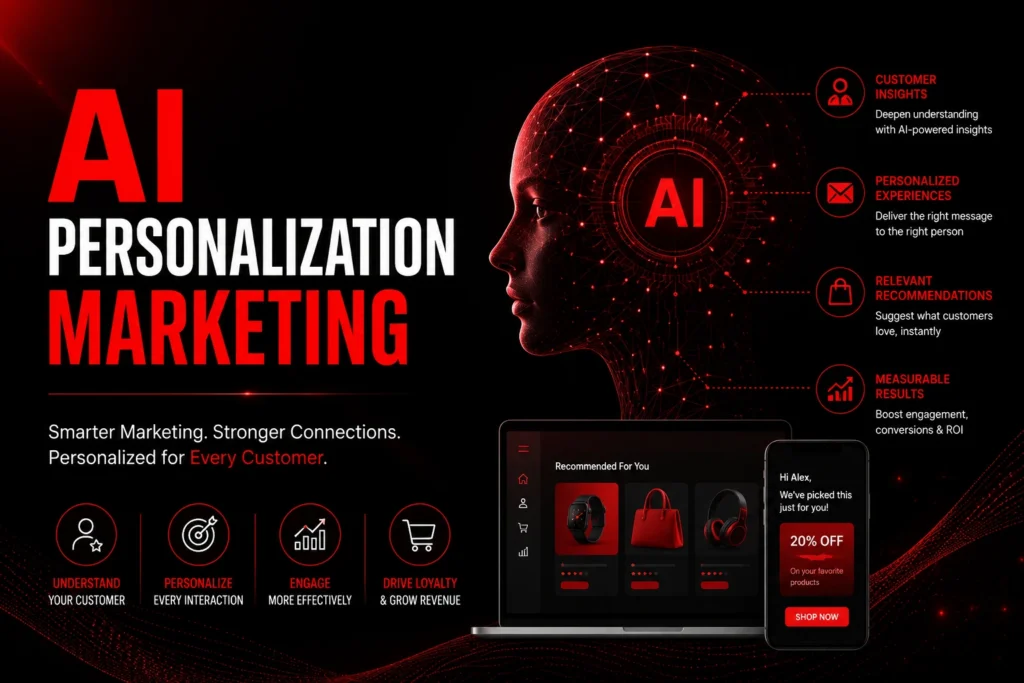
AI personalisation marketing delivers dynamically generated, individually tailored content, offers, and experiences to each user in real time based on their behaviour, intent signals, and context, rather than grouping them into static audience segments.
What is AI Personalisation Marketing: A marketing approach that uses machine learning and generative AI to create unique, context-aware content, messaging, and offers for individual users at scale, placing broad audience segmentation with real-time, 1:1 relevance across every channel and touchpoint.
The operational difference is fundamental. Traditional personalisation says: “This user is in our ‘high-intent, mid-funnel’ segment, so show them case study content.” AI personalisation says: “This specific user just viewed the pricing page twice, came from a LinkedIn ad targeting fintech founders, is browsing on a Tuesday at 11 pm, and hasn’t opened our last two emails. Here’s the exact message that addresses their specific hesitation right now.” The segment was a proxy for individual intent. AI removes the need for the proxy.
Why AI Personalisation Marketing Is Replacing Segment-Based Targeting
Segment-based targeting is being replaced by AI personalisation marketing because segments average out individual signals, creating messaging that’s relevant to no one in particular, and AI can now process individual signals in real time at scale.
Traditional segmentation groups users by shared characteristics, demographics, purchase history, and funnel stage. The assumption is that users in the same segment will respond similarly to the same message. That assumption was always a compromise. A 32-year-old startup founder in Mumbai and a 32-year-old corporate manager in Chennai may share segment attributes but have completely different purchase motivations, content preferences, and timing sensitivities. A single segmented message addresses both of them imprecisely.
According to Salesforce’s 2025 State of Marketing report, 73% of consumers expect brands to understand their individual needs, but only 30% of marketers believe they’re delivering on that expectation. The gap between expectation and delivery is exactly where AI personalisation marketing operates.
The 4 Layers of AI Personalisation Marketing in 2026
Modern AI personalisation marketing operates across four interconnected layers, each one adding a dimension of individual relevance that static segmentation can’t replicate.
Layer 1: Behavioural Signal Processing
AI systems process individual user behaviour in real time, pages visited, content consumed, time spent, scroll depth, clicks, and search queries, building a live intent model for each user. This goes far beyond segment assignment. The AI isn’t categorising the user; it’s predicting what they need next based on what they’ve actually done in the last 30 minutes, not what their demographic profile suggests they might do.
Layer 2: Generative Content Personalisation
Generative AI produces individually tailored content variants, email subject lines, landing page headlines, ad copy, product descriptions, and push notifications calibrated to each user’s specific context. This is not A/B testing at scale. It’s the AI generating a unique combination of message, tone, offer, and call-to-action for each individual, informed by their full behavioural history.
Layer 3: Predictive Offer Optimisation
AI personalisation marketing predicts which offer, incentive, or next action is most likely to convert a specific individual, based on their purchase history, browsing pattern, and comparative behaviour against similar users. Instead of offering a blanket 20% discount to an “at-risk” segment, the AI identifies that this specific user responds to social proof, and serves them a customer testimonial from a similar profile rather than a discount they’d have converted without anyway.
Layer 4: Cross-Channel Experience Continuity
AI systems maintain individual user context across every channel, email, paid social, website, SMS, push notification, and sales outreach, ensuring each touchpoint builds on the last rather than resetting to generic segment messaging. A user who engaged with a specific product video on Instagram sees that exact product in their email, their retargeting ad, and their website homepage banner, not because a marketer manually configured three campaigns, but because the AI maintains a unified individual experience model across all channels simultaneously.
Real-World Example: How a Bengaluru D2C Brand Replaced Segments With AI Personalisation Marketing
A Bengaluru-based D2C skincare brand was running traditional email segmentation: four audience buckets (new subscribers, active buyers, lapsed customers, VIPs) with four corresponding campaign flows. The approach was considered “advanced” by most e-commerce standards. Their email revenue was flat despite list growth.
In Q2 2025, they implemented an AI personalisation marketing stack using Klaviyo’s AI features integrated with a custom behavioural data layer. The results from the first 90 days:
- Subject line personalisation
AI-generated individual subject lines based on each subscriber’s past open behaviour, preferred content type, and last product interaction. Open rates increased from 22% to 34%.
- Product recommendation personalisation
AI replaced static “bestsellers” blocks with individually predicted product recommendations. Email click-through rates doubled from 3.1% to 6.4%.
- Send time optimisation
AI predicted the optimal send window for each subscriber rather than blasting the list at a single time. Revenue per email sent increased 28%.
- Lapsed customer reactivation Instead of a generic win-back offer, AI personalised the reactivation message to each user’s original purchase category and most recent browsing session. Reactivation rate tripled compared to the previous segment-based flow.
Executing AI personalisation marketing on social channels requires the same individual-level thinking applied to paid and organic distribution. A social media marketing company that builds AI personalisation into content distribution and paid targeting, rather than defaulting to demographic segments, delivers the kind of engagement lift that segment-based social campaigns simply can’t produce anymore.
AI Personalisation Marketing for Indian Businesses: Where to Start
Most Indian businesses assume AI personalisation marketing requires enterprise infrastructure and a data science team. It doesn’t. Here’s a practical entry path for businesses at any scale.
Start With Email: The Highest-ROI Personalisation Channel
Email personalisation delivers the fastest measurable ROI for any AI personalisation investment. Platforms like Klaviyo, MoEngage, and WebEngage are all widely used by Indian e-commerce and SaaS brands ave AI personalisation features built in. The gap between using these tools at the segment level versus the individual level is a configuration decision, not a technology barrier.
Personalise Your Landing Pages by Traffic Source and Intent
Tools like Mutiny and Personyze allow you to dynamically change headline copy, imagery, and social proof based on where the visitor came from and what they’ve previously engaged with. A visitor from a Google Ad targeting “CRM software for startups” and a visitor from a LinkedIn ad targeting “VP Sales at enterprise companies” should not see the same landing page, and with AI personalisation tools, they don’t have to.
Build Behavioural Trigger Workflows, Not Time-Based Sequences
Replace time-based email sequences “Day 1, Day 3, Day 7 after signup” with behaviour-triggered workflows where the AI sends the next message when the user’s actions indicate they’re ready for it. This shift alone typically improves conversion rates by 20–35% on existing nurture sequences without any new content creation.
How to Implement AI Personalisation Marketing: A Step-by-Step Plan
Here’s the implementation roadmap for Indian businesses ready to move from segments to individual-level AI personalisation.
- Audit your current data infrastructure. AI personalisation requires individual-level behavioural data. Confirm you’re capturing page views, product interactions, email engagement, and purchase events at the user level, not just in aggregate. If you’re not, this is the first fix.
- Choose your highest-impact channel for the first pilot.
Email for e-commerce and SaaS. Website landing pages for B2B with paid traffic. Push notifications for mobile-first consumer apps. Start where the feedback loop is fastest, and the data is richest.
- Activate AI features inside your existing platforms.
Before buying new tools, check whether your current email platform, CRM, or ad platform has AI personalisation features you’re not using. Klaviyo, HubSpot, MoEngage, and Salesforce Marketing Cloud all have AI personalisation capabilities that most Indian businesses haven’t activated.
- Define the personalisation variables that matter most for your use case.
Not all personalisation is equally impactful. For most Indian e-commerce brands, product recommendation and send time personalisation deliver the highest lift fastest. For B2B SaaS, message tone and use-case alignment matter more than visual personalisation.
- Set up individual-level tracking across channels. AI personalisation across email, ads, and website requires a unified customer identifier connecting behaviour across touchpoints. Implement a customer data platform or configure your existing analytics stack to maintain cross-channel individual profiles.
- Measure the right metrics.
Track revenue per recipient (not just open rate), conversion rate by individual personalisation variable, and lifetime value trajectory for AI-personalised cohorts versus control groups. These metrics reveal compounding value that engagement metrics alone don’t capture.
Frequently Asked Questions
Q: What is AI personalisation marketing, and how does it differ from traditional personalisation?
A: AI personalisation marketing delivers individually tailored content, offers, and experiences to each user in real time based on their specific behaviour and intent, rather than grouping users into broad segments and sending the same message to everyone in the bucket. The difference is individual relevance versus approximate relevance, at scale and without manual configuration.
Q: Is AI personalisation marketing only for large enterprises in India?
A: No. Platforms like Klaviyo, MoEngage, and WebEngage bring AI personalisation capabilities to Indian SMEs and startups at accessible price points. The minimum requirement isn’t budge,t it’s individual-level behavioural data. Any business collecting user-level engagement data across at least one channel can begin deploying AI personalisation marketing without an enterprise infrastructure.
Q: What data do I need to start AI personalisation marketing?
A: At minimum, individual-level behavioural data: page views, product interactions, email engagement events, and purchase history linked to a persistent user identifier. You don’t need a data warehouse to start. Most e-commerce and SaaS platforms already collect this data; the gap is connecting it to a personalisation engine that uses it for individual-level decision-making rather than segment assignment.
Q: How quickly does AI personalisation marketing show results?
A: Email personalisation typically shows measurable lift within the first 30 days. Open rates, click rates, and revenue per recipient are fast-feedback metrics. Landing page and ad personalisation show results within 60 days as the AI accumulates enough behavioural data to make reliable predictions. Full cross-channel personalisation compounds over 90–180 days as individual user models become richer.
Q: Can AI personalisation marketing work for B2B Indian businesses?
A: Yes, and B2B often sees a higher personalisation lift than B2C because purchase decisions are higher-stakes and more research-intensive. Personalising landing pages by industry vertical, job function, and company size; tailoring email nurture sequences to specific use cases; and adjusting ad messaging by seniority level all deliver measurable pipeline improvement for Indian B2B companies with even basic behavioural data infrastructure.
Audience segments were a constraint imposed by the limits of what technology could do. AI personalisation marketing removes that constraint, and the Indian businesses that shift from segment-level thinking to individual-level relevance now are building a conversion advantage that compounds with every additional user interaction their AI models learn from.
Want to stay ahead of AI-driven marketing? Book a free consultation with DigitalUltras.
