
RAG vs Fine-Tuning vs Prompting: How to Pick the Right AI Strategy for Your Business
82% of businesses that attempted AI fine-tuning in 2024 abandoned the project before deployment, citing cost overruns and longer-than-expected timelines, according to a 2025 Andreessen Horowitz enterprise AI survey. The problem wasn’t the technology. It was choosing the wrong AI customisation strategy for the use case. Understanding RAG vs fine-tuning AI and knowing when to use neither and just engineer your prompts better is the decision that separates teams that ship working AI products from teams that burn six months and ₹50 lakh on an approach that was never right for the job.
This post gives you a clear, jargon-light breakdown of all three strategies, rompting, RAG, and fine-tuning, with a direct comparison, real-world examples, and a decision framework you can use today.
RAG vs Fine-Tuning AI: Why This Decision Matters
Choosing wrong between RAG vs fine-tuning AI doesn’t just waste money, it delays your AI deployment by months and produces an inferior product compared to the right approach implemented correctly.
Most businesses approaching LLM customisation default to whichever approach they’ve heard of most recently. Fine-tuning sounds powerful. RAG sounds sophisticated. But the right choice is entirely determined by what problem you’re trying to solve, and for the vast majority of business use cases, the answer isn’t the most complex option. According to a 2025 Databricks State of Data + AI report, RAG outperforms fine-tuning for knowledge-intensive business applications in 78% of benchmark tests at a fraction of the cost and implementation time. That stat alone reframes how most Indian businesses should be thinking about this decision.
What Is Prompting? The Starting Point for Every AI Strategy
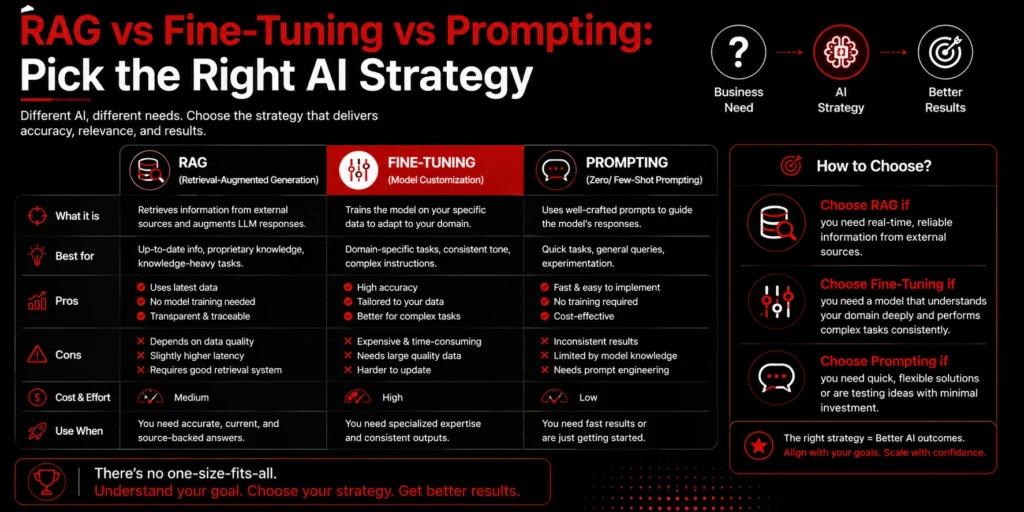
Prompting is the baseline AI customisation approach, shaping an LLM’s output through carefully crafted instructions without modifying the model’s underlying weights or augmenting it with external data.
Prompting is underestimated by most businesses rushing toward RAG or fine-tuning. Done well, a system prompt with clear role definition, relevant context, output constraints, and few-shot examples solves 60–70% of business AI use cases without any additional infrastructure. Before evaluating RAG vs fine-tuning AI, ask whether better prompt engineering would already deliver what you need. Most of the time, it will.
- Cost: zero additional infrastructure; only engineering time
- Speed to deploy: hours to days
- Best for: consistent tone, format requirements, role-specific behaviour, task instructions
- Limitations: can’t inject real-time data, can’t reliably access private knowledge, context window limits what you can include per prompt
What Is RAG? The Right Choice for Knowledge-Intensive Business Applications
RAG is the most commercially practical approach for businesses that need AI to answer questions using their own private data, live information, or document libraries without training a new model.
Here’s why RAG wins the RAG vs fine-tuning AI comparison for most Indian businesses. Fine-tuning bakes knowledge into the model permanently wh, which means every time your data changes, you need to retrain. RAG retrieves live data at query time, so your AI always works with current information. For businesses with product catalogues, policy documents, support knowledge bases, or any data that updates regularly, RAG is structurally superior.
- Cost: moderate, requires vector database setup and embedding pipeline, but no GPU training costs.
- Speed to deploy: days to weeks, depending on data complexity
- Best for: customer support bots with live product data, internal knowledge assistants, document Q&A systems, sales enablement tools with current pricing and collateral
- Limitations: retrieval quality depends on how well your data is chunked and indexed; it doesn’t change the model’s tone, style, or behavioural defaults
What Is Fine-Tuning? The Right Choice for Behaviour and Style Changes
Fine-tuning retrains a base LLM on your specific data to permanently alter how the model behaves in terms of its tone, reasoning style, domain expertise, or task-specific output format.
In the RAG vs fine-tuning AI comparison, fine-tuning wins for a narrow but important set of use cases. If you need a model that consistently writes in a very specific brand voice across thousands of outputs, follows a proprietary reasoning methodology, or produces highly structured outputs in a domain-specific format, fine-tuning delivers what prompting and RAG cannot. The model internalises the behaviour rather than following instructions about it.
- Cost: high GPU compute costs, data preparation, testing cycles, and ongoing retraining as your requirements evolve
- Speed to deploy: weeks to months for a production-quality fine-tuned model
- Best for: consistent brand voice at massive scale, domain-specific classification, proprietary reasoning frameworks, medical or legal applications with highly specialised output requirements
- Limitations: expensive to update when data or requirements change; hallucination risk increases with narrow training datasets; most business use cases don’t justify the cost
RAG vs Fine-Tuning AI: Direct Comparison
Here’s the side-by-side breakdown that cuts through the noise on RAG vs fine-tuning AI for business decision-makers.
- Data updates: RAG handles live, changing data natively, and fine-tuning requires full retraining for every significant knowledge update
- Implementation cost: RAG is moderately priced; fine-tuning carries 5–10x the cost of RAG for comparable deployment scope
- Time to production: RAG in days to weeks; fine-tuning in weeks to months
- Output consistency: fine-tuning delivers more consistent tone and style; RAG output quality depends on retrieval precision
- Best use case fit: RAG for knowledge access and accuracy; fine-tuning for behaviour and style internalisation
The practical recommendation for Indian businesses: start with prompting, graduate to RAG when your use case requires private or dynamic data, and evaluate fine-tuning only when you have a specific behavioural requirement that RAG plus prompting can’t solve and a budget that reflects the real cost.
A Real-World Case Study: How a Delhi LegalTech Startup Chose Between RAG vs Fine-Tuning AI
A Delhi-based LegalTech startup building an AI contract review tool faced a classic RAG vs fine-tuning AI decision in early 2025. Their product needed to review uploaded contracts, identify non-standard clauses, and flag risk, all referencing their proprietary legal playbook of 400+ clause standards.
They initially scoped a fine-tuning project, estimating ₹18 lakh and four months. A technical review led them to reconsider. The core question was: Does this AI need to know things differently, or does it need to access specific information accurately?
Building this kind of AI architecture requires both LLM expertise and full-stack engineering capability working together. That’s why working with a full-stack development agency that understands AI system design end-to-end, not just the prompt layer, makes the difference between a product that ships and a project that stalls at the architecture decision stage
.
How to Choose Between Prompting, RAG, and Fine-Tuning: A Step-by-Step Framework
Stop debating approaches in the abstract. Use this decision framework to reach the right answer in under 20 minutes.
- Define your AI use case in one sentence. “I need AI to [do X] using [data source Y] for [user Z].” If you can’t write this sentence, you’re not ready to choose an architect; you’re still defining the problem.
- Ask: Does the AI need to access data that isn’t in its training?
If yes, private documents, live CRM data, product catalogues, policy manuals,s you need RAG. Prompting alone can’t access external data, and fine-tuning bakes staticdatan permanently.
- Ask: Does the data change regularly? If yes, RAG is almost always the right answer over fine-tuning. Regularly updating a fine-tuned model is expensive and time-consuming; updating a RAG knowledge base is a data pipeline operation.
- Ask: Does the AI need to behave differently from the base model, not just access different information?
If the requirement is a specific reasoning style, proprietary output format, or domain-specific tone that prompting can’t reliably deliver at scale, now you have a genuine fine-tuning case.
- Try better prompting first, always.
Before scoping a RAG or fine-tuning project, spend two days optimising your system prompt with role definitions, a few-shot examples, and output constraints. You may solve 80% of the problem without any infrastructure investment.
Frequently Asked Questions
Q: What is the difference between RAG and fine-tuning AI?
A: RAG connects an AI model to external data at query time, the model retrieves relevant information and uses it to answer accurately without being retrained. Fine-tuning retrains the model’s internal parameters on new data, permanently changing how it reasons or responds. RAG suits dynamic knowledge needs; fine-tuning suits behavioural or style customisation at scale.
Q: When should an Indian startup choose RAG over fine-tuning?
A: Choose RAG when your AI needs to access private, proprietary, or frequently updated data product catalogues, policy documents, or support knowledge bases. RAG is faster to deploy, significantly cheaper, and easier to update than fine-tuning. For most Indian startups with limited AI budgets, RAG delivers better ROI than fine-tuning for 80% of knowledge-intensive use cases.
Q: Is fine-tuning AI worth the cost for small businesses?
A: Rarely. Fine-tuning requires substantial data preparation, GPU compute costs, and ongoing retraining as your requirements evolve. For most small business use cases, well-engineered prompting or an RAG architecture delivers equivalent output quality at a fraction of the cost. Fine-tuning justifies its expense only when consistent behavioural customisation at high volume is a core product requirement.
Q: Can you combine RAG and fine-tuning in the same AI system?
A: Yes, and for advanced enterprise applications, combining both often produces the best results. A fine-tuned model handles domain-specific reasoning and consistent behaviour; RAG layers provide access to live, proprietary data at query time. For most Indian businesses, however, RAG alone meets requirements without the additional complexity and cost of adding fine-tuning on top.
Q: How do I know if my AI use case needs RAG vs fine-tuning?
A: Ask two questions: Does the AI need to access data that updates regularly? If yes, use RAG. Does the AI need to behave fundamentally differently from the base model reasoning style, proprietary format, or domain-specific tone in ways that can’t reliably be produced at scale? If yes, consider fine-tuning. If neither condition applies strongly, invest in better prompt engineering first.
Want to stay ahead of AI-driven marketing? Book a free consultation with DigitalUltras.
