
No Click, No Problem: Your Zero-Click SEO Strategy for 2026
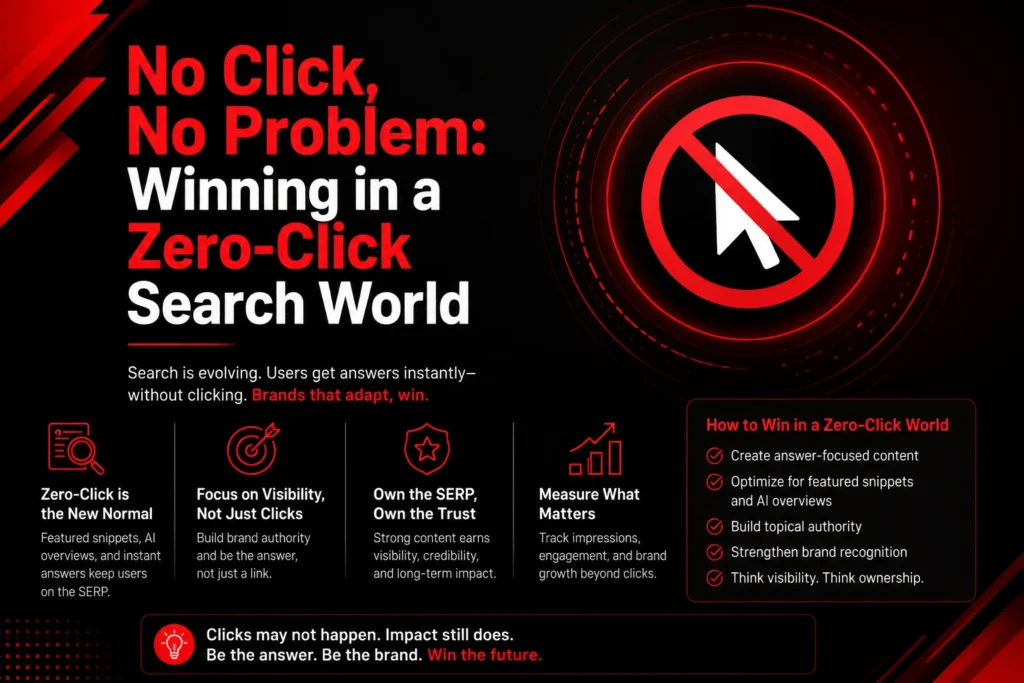
More than 60% of Google searches now end without a single click to any website, according to SparkToro’s 2025 zero-click study. If your entire marketing strategy depends on someone visiting your site from a search result, you’ve built on a foundation that’s actively shrinking. A smart zero-click SEO strategy doesn’t fight this shift; it works with it, turning AI Overviews, featured snippets, and knowledge panels into brand-building tools that generate awareness, trust, and demand even when no click happens.
This post covers exactly what zero-click SEO is, why it’s actually an opportunity for Indian businesses, which tactics build brand equity without requiring a click, and a step-by-step plan to turn AI search visibility into real commercial outcomes.
What Is a Zero-Click SEO Strategy?
A zero-click SEO strategy optimises your content to appear inside AI Overviews, featured snippets, knowledge panels, and AI chat answers,s building brand visibility and authority even when users never click through to your website.
What is a Zero-Click SEO Strategy: A search visibility approach that prioritises brand citation, accurate entity representation, and answer-format content so your brand gains awareness and trust inside AI-generated search results, regardless of whether a user visits your site.
The mindset shift is critical. Traditional SEO measures success by traffic. Zero-click SEO measures success by brand mention share, citation frequency, and the downstream commercial sign, such as branded search volume, direct traffic, and higher-intent visit quality that zero-click brand exposure drives. According to Semrush’s 2025 AI Visibility Report, brands cited in AI Overviews see a 27% increase in branded search volume within 90 days, even without a corresponding rise in organic clicks. The click isn’t the outcome. The brand impression is.
Why Zero-Click SEO Strategy Is an Opportunity, Not a Threat
Zero-click search isn’t stealing your audience; it’s introducing your brand to a larger one, faster than a click-dependent strategy ever could.
Consider the math. A branded mention inside a Google AI Overview is seen by every user who triggers that query, not just the 5–10% who would have clicked your organic result. Your brand gets seen by 100% of the audience that searches the query, not the fraction willing to click a blue link. If that mention is accurate, favourable, and positions you correctly, it creates a trust impression at scale that no paid ad can replicate at the same cost.
Indian businesses in competitive categories, fintech, edtech, SaaS, D2C, and professional services are sitting on an underutilised opportunity right now. Most competitors are still obsessing over click-through rates while the AI answer layer above their results goes uncontested. The brands that build a deliberate zero-click SEO strategy in 2026 are claiming real estate their competitors haven’t even noticed yet.
The 5 Core Pillars of a Zero-Click SEO Strategy
A winning zero-click SEO strategy rests on five interconnected pillars, each one building the brand authority that AI systems draw from when generating answers.
Pillar 1: Answer-First Content Structure
Every piece of content you publish needs to lead with its answer, not build toward it. AI systems extract the first clear, declarative statement from a section. If your content spends three sentences setting context before answering the question, it won’t get cited. Rewrite every H2 section opening to state the answer immediately, then elaborate. This single structural change is the highest-ROI action in any zero-click SEO strategy.
Pillar 2: Entity Authority Building
AI systems recognise and cite brands that appear consistently across authoritative sources, your website, Google Business Profile, industry directories, press mentions, review platforms, and knowledge graphs. The more consistently your brand is described with the same positioning across credible sources, the more confidently AI tools represent you. Entity authority is the brand signal that zero-click search rewards most heavily.
Pillar 3: Schema Markup Implementation
FAQ schema, HowTo schema, Article schema, and Organisation schema tell Google’s systems exactly how to understand and categorise your content. Pages with FAQ schema are cited in AI Overviews at 2.7x the rate of unstructured pages, according to Semrush’s 2025 data. Schema is the technical layer that turns well-written content into machine-readable, citable content.
Pillar 4: Topical Depth and Content Clusters
A single strong article doesn’t build enough topical authority for AI systems to treat your domain as a category expert. You need a content cluster: a pillar page supported by 6–10 related articles, a glossary of key terms, and at least one original data piece. AI search visibility compounds with topical depth. The more comprehensive your coverage of a topic, the more frequently AI tools reach for your domain as a source.
Pillar 5: Third-Party Citation and PR
AI tools weigh content from high-authority third-party sources more heavily than self-published brand content. A mention in Economic Times, Inc42, YourStory, or a credible industry publication carries significantly more AI citation weight than the same information published on your own blog. Earned media is no longer just a brand awareness play; it’s a direct input into your zero-click SEO strategy and AI answer visibility.
Zero-Click SEO and Lead Generation: How They Connect
The most common objection to zero-click SEO is straightforward: if nobody clicks, how does it generate leads? The answer is that it works upstream of the click, building the brand familiarity and trust that makes every downstream touchpoint more effective.
Here’s the commercial flow that zero-click brand visibility creates:
- Prospect searches a category query “best SaaS tools for HR management in India” and sees your brand cited in an AI Overview
- No click happens, but your brand name registers as a credible player in the category
- Prospect searches your brand name directly, and days late, a branded search that provides zero-click exposure
- They visit your site with significantly higher purchase intent than a cold organic visitor
- Your retargeting campaigns reach them on Meta and Google with warmer audience data
- Your sales team closes a prospect who already trusts your brand before the first conversation
This is why branded search volume is the leading indicator metric for a working zero-click SEO strategy, not organic traffic. If your brand citations are growing but your branded search isn’t, something is broken in the entity authority layer. If both are growing, you’ve built a sustainable demand engine.
For businesses where lead volume is the primary commercial objective, connecting a zero-click brand strategy with conversion-focused paid and organic campaigns creates the full funnel. A lead generation company in Delhi that understands both AI search visibility and bottom-funnel conversion can bridge the gap between brand impression and qualified pipeline rather than treating them as separate strategies.
A Real-World Case Study: How a Gurugram B2B Brand Built a Pipeline From Zero-Click Visibility
A Gurugram-based B2B logistics SaaS company had strong organic rankings but declining click-through rates, a classic zero-click squeeze. Rather than chasing clicks, their marketing team leaned into a deliberate zero-click SEO strategy over Q1 2026.
They made four targeted moves:
- Restructured their top 15 blog posts with answer-first H2 openings and added definition boxes for every key logistics and supply chain term
- Implemented FAQ schema across all top pages, targeting 22 “People Also Ask” queries directly relevant to their ICP
- Secured three editorial placements in Supply Chain India, CIO Insider, and Logistics Insider, each explicitly describing their enterprise positioning and differentiators.
- Updated their Crunchbase, G2, and Clutch profiles with current product descriptions and fresh customer reviews
Results after 90 days: AI Overview citations for 11 target queries (up from zero), branded search volume up 31%, direct traffic up 19%, and inbound demo requests up 24% without any increase in paid spend. The zero-click visibility created awareness that converted into a measurable pipeline through branded search and direct intent.
Step-by-Step Zero-Click SEO Strategy Implementation Plan
Here’s your execution roadmap, practical, prioritised, and built for Indian marketing teams.
- Audit your current AI search visibility.
Search your top 20 keywords in Google AI Overviews, ChatGPT, and Perplexity. Record where your brand appears, where it’s absent, and where it’s inaccurately represented. This baseline drives every subsequent decision.
- Rewrite H2 section openings on your top 10 pages.
Lead with the answer. Remove all preamble from the first sentence of every major section. This is the single highest-impact structural change in any zero-click SEO strategy.
- Add definition boxes for every key industry term.
Format: bolded term + one precise sentence. Prioritise terms your ICP is likely to search. These are your highest-value AI extraction points.
- Implement the FAQ schema on your top 20 pages. Use RankMath or Yoast, both of which support the FAQ schema without code. Target questions your ICP actually asks, not keyword-stuffed variations.
- Publish two original research pieces per quarter. Even a 50-customer survey generates proprietary data that AI tools can cite and that competitors can’t replicate. Original data is the strongest AI citation signal available to brand publishers.
- Pitch three editorial placements per quarter. Target publications your readsread: industry trade press, national business media, and category-specific platforms. Each placement is both a PR win and a direct AI citation signal.
- Track branded search volume monthly. This is your primary zero-click SEO KPI. Rising branded search volume is the most reliable indicator that your AI search visibility is converting into commercial demand. Use Google Search Console branded query filters to isolate and track this signal cleanly.
Frequently Asked Questions
Q: What is a zero-click SEO strategy, and does it actually work?
A: A zero-click SEO strategy optimises your content for AI Overviews, featured snippets, and knowledge panels,s building brand visibility even when no click occurs. It works by driving branded search volume, direct traffic, and higher-intent visits downstream from AI-generated brand impressions. Brands cited in AI Overviews see measurable branded search increases within 90 days.
Q: How do I measure success if nobody is clicking my search results?
A: Measure branded search volume growth, direct traffic trends, AI citation frequency across ChatGPT and Perplexity, and share-of-voice in AI-generated category answers. These upstream signals are leading indicators of commercial demand. Rising branded search is the clearest proof that zero-click brand exposure is converting into genuine purchase intent further down the funnel.
Q: Is a zero-click SEO strategy different from traditional SEO?
A: Yes, traditional SEO optimises for ranked clicks; a zero-click SEO strategy optimises for cited brand presence inside AI-generated answers. Both share the same content quality and authority foundations, but zero-click SEO adds answer-first structure, schema markup, entity authority building, and third-party citation as primary optimisation targets rather than keyword-driven rank positions.
Q: Which industries benefit most from a zero-click SEO strategy in India?
A: Any category where buyers research extensively before purchasing B2B SaaS, fintech, edtech, professional services, healthcare, and D2C brands in the considered-purchase categories. If your customers ask questions before buying, they’re encountering AI answers before they encounter your website. A zero-click SEO strategy ensures those AI answers include your brand, accurately and favourably.
Q: Can a zero-click SEO strategy replace paid advertising?
A: It shouldn’t be that the two strategies amplify each other. Zero-click SEO builds the brand trust that makes paid ads convert at higher rates. Paid ads reach audiences who’ve already seen your brand in AI answers, with warmer intent and lower resistance. The strongest 2026 marketing stacks combine deliberate zero-click brand visibility with conversion-focused paid campaigns, not one or the other.
Want to stay ahead of AI-driven marketing? Book a free consultation with DigitalUltras.
