
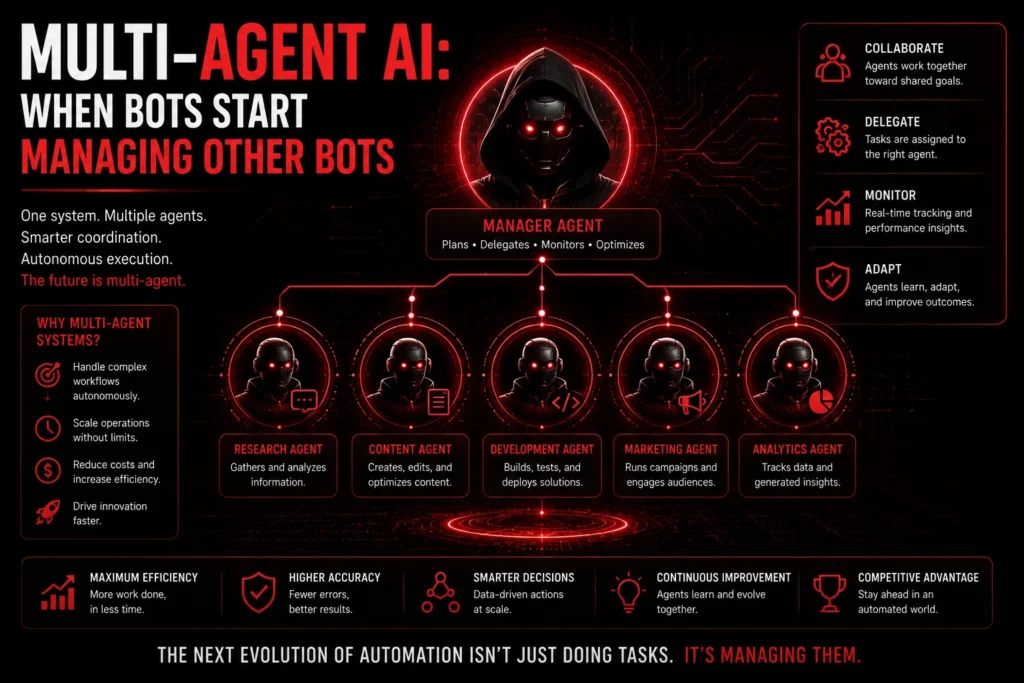
Introduction: Multi-Agent AI Systems: When Bots Start Managing Other Bots
By 2027, Gartner predicts that 25% of enterprise software applications will include autonomous AI agents capable of directing other agents, up from under 1% in 2024. That shift is already playing out in forward-thinking businesses right now. Multi-agent AI systems, networks of specialised AI agents that coordinate, delegate, and check each other’s work, are moving from research labs into real marketing, operations, and product workflows.
In this post, you’ll learn exactly what multi-agent AI systems are, how AI orchestration works in practice, which business functions they’re transforming first, the risks you need to plan for, and a practical framework for deploying your first agent network without needing a team of machine learning engineers to do it.
What Are Multi-Agent AI Systems?
Multi-agent AI systems are architectures in which multiple AI agents, each with a defined role and capability set, collaborate autonomously to complete complex, multi-step tasks that a single agent couldn’t handle alone.
What are Multi-Agent AI Systems: A networked configuration of specialised AI agents that communicate, delegate subtasks, verify each other’s outputs, and work in parallel toward a shared objective managed by an orchestrator agent that coordinates the entire workflow.
Think of it like an AI org chart. You have a manager agent at the top, the orchestrator that breaks down a goal into subtasks and assigns them to specialist agents. A research agent pulls data. A content agent drafts the output. A quality agent reviews it. A publishing agent distributes it. Each agent is optimised for its specific function, and the orchestrator ensures they work in sequence or in parallel, with no human intervention between steps.
According to a 2025 Forrester report, businesses deploying multi-agent AI systems complete complex workflows 60% faster than those using single-agent or manual processes with measurably fewer errors at each stage.
How Multi-Agent AI Systems Work: The Core Architecture
Understanding the architecture of multi-agent AI systems helps you evaluate which workflows in your business are ready for this level of automation.
The Orchestrator Agent
The orchestrator is the command layer of any multi-agent AI system. It receives the high-level objective, decomposes it into discrete subtasks, assigns those tasks to the right specialist agents, monitors progress, handles errors, and synthesises the final output. Without a well-configured orchestrator, a multi-agent network devolves into competing tasks with no coherent output.
Specialist Worker Agents
Worker agents are optimised for specific functions: web research, data analysis, content generation, code execution, API calls, form submissions, or customer communication. Each agent operates within a defined scope; it doesn’t need to know the full workflow, only its assigned task and where to send the output.
Memory and Context Layers
Multi-agent AI systems use shared memory stores, typically vector databases, that allow agents to pass context between each other without losing information across steps. This is what allows a research agent’s findings to inform a content agent’s draft without a human manually copying data between tools.
Human-in-the-Loop Checkpoints
Well-architected multi-agent AI systems include defined points where a human reviews and approves output before the next agent acts. These checkpoints are not optional for high-stakes workflows; they’re the safeguard that prevents one agent’s error from cascading through the entire pipeline undetected.
Multi-Agent AI Systems in Action: Real Business Use Cases
Multi-agent AI systems aren’t theoretical; they’re already running inside forward-thinking businesses across marketing, operations, and product functions.
End-to-End Content Marketing Pipelines
A content marketing multi-agent AI system might work like this: an orchestrator receives a monthly content brief, assigns keyword research to a research agent, passes findings to a content agent that drafts the posts, routes drafts to a quality agent that checks for accuracy and SEO structure, and sends approved posts to a publishing agent that schedules them directly in WordPress. The entire pipeline from brief to published post runs with one human approval checkpoint, not five.
Autonomous E-Commerce Operations
E-commerce brands are deploying agent networks where a pricing agent monitors competitor prices every four hours, an inventory agent tracks stock levels across platforms, an ad agent adjusts bid strategies based on margin data from the pricing agent, and a customer service agent handles post-purchase queries, all coordinated by an orchestrator that prevents conflicting actions. This is AI orchestration at its most commercially impactful.
Sales Pipeline Automation
In B2B sales, multi-agent systems qualify leads, score them against ICP criteria, personalise outreach sequences, schedule follow-ups, and update CRM records without a sales rep involved until a lead crosses a defined engagement threshold. The agents hand off to a human at exactly the right moment, not a minute sooner.
A Real-World Case Study: How a Mumbai Fintech Used Multi-Agent AI to Scale Operations
A Mumbai-based fintech startup offering personal finance tools had a content and compliance challenge: every piece of financial content they published needed research, drafting, compliance review, and SEO optimisation, a process that was taking their team 4–5 days per article and bottlenecking their growth.
They deployed a four-agent content system in Q2 2025:
- Research Agent: pulled SEBI guidelines, RBI circulars, and competitor content relevant to each topic using live web access
- Content Agent: drafted articles structured for both SEO and GEO citation, using the research agent’s output as its knowledge base
- Compliance Agent: reviewed every draft against a pre-loaded set of SEBI and IRDAI communication guidelines, flagging non-compliant language before human review.
- SEO Agent: scored the final draft against live SERP data and suggested structural improvements before publishing
The result: article production time dropped from 4.5 days to 18 hours. Compliance review time dropped by 70%. The team published 3x more content per month with no additional headcount, and organic traffic grew 44% over the following quarter.
That kind of compound output gain is what separates businesses using multi-agent AI systems from those still running on linear, manual workflows.
AI Orchestration Frameworks: What Powers Multi-Agent Systems
AI orchestration is the technical discipline of coordinating agent networks, and knowing the major frameworks helps you evaluate what’s possible without a PhD in machine learning.
What is AI Orchestration: The coordination layer that manages how multiple AI agents communicate, share context, execute tasks in the correct sequence, and handle errors within a multi-agent system.
The leading orchestration frameworks in 2026 include:
- LangGraph: graph-based orchestration built on LangChain; best for complex, branching workflows with conditional logic
- AutoGen (Microsoft): a multi-agent conversation framework where agents collaborate through structured dialogue; strong for code generation and analysis tasks
- CrewAI: a role-based agent framework designed for business workflows; most accessible for non-ML teams building agent networks
- Amazon Bedrock Agents: cloud-native multi-agent orchestration with built-in security and enterprise compliance; strong for Indian businesses with data residency requirements
- OpenAI Swarm: lightweight handoff-based framework for teams already operating inside the OpenAI ecosystem
For most Indian businesses and agencies, CrewAI and LangGraph offer the best entry point capable enough for production workflows, accessible enough for teams without dedicated ML engineering resources.
The Risks of Multi-Agent AI Systems You Must Plan For
Multi-agent AI systems introduce failure modes that don’t exist in single-agent setups, nd ignoring them creates expensive problems at scale.
- Error amplification: a hallucinated fact from a research agent becomes the input for every downstream agent. Without a quality checkpoint, the error compounds silently through the workflow.
- Agent conflict: Two agents with overlapping mandates can take contradictory actions simultaneously. A pricing agent dropping prices while an ad agent increases bids on the same SKU is a real scenario without proper scope definition.
- Runaway execution: agents with access to external APIs can execute actions, sending emails, placing bids, and publishing content faster than humans can review them. Permission scoping and rate limits are non-negotiable safeguards.
- Context drift: over long workflows, agents can lose track of the original objective and optimise for sub-goals that don’t serve the actual business outcome. Regular orchestrator check-ins and objective anchoring prevent this.
- Data exposure: agents with access to sensitive business or customer data need strict permission layers. A customer service agent should never have access to financial data it doesn’t need to function.
The safest approach is progressive trust: deploy multi-agent AI systems in low-stakes workflows first, observe how the network behaves under real conditions, then expand to higher-stakes functions once you’ve validated the error-handling and checkpoint architecture.
How Indian Businesses Should Deploy Multi-Agent AI Systems: A Step-by-Step Framework
Here’s a practical deployment roadmap built for Indian business owners and marketing managers, no ML engineering background required.
- Identify a complex, multi-step workflow with clear inputs and outputs. Content production, lead qualification, and competitive research are ideal starting points. Avoid workflows where errors have immediate financial consequences until you’ve validated your setup.
- Map the workflow into discrete agent roles. Write down every step in your current process and identify which steps require research, which require generation, which require review, and which require action. Each category maps to a specialist agent type.
- Choose your orchestration framework based on technical capacity. CrewAI for teams without ML engineers. LangGraph for teams with some Python capability. Amazon Bedrock for enterprise compliance requirements.
- Define agent scope and permissions explicitly. Every agent should have a written mandate: what it’s allowed to do, what data it can access, and what it must not act on without human approval. Vague mandates produce unpredictable agents.
- Build at least one human review checkpoint into every pipeline. Place it at the highest-risk handoff, typically before external actions like publishing, emailing, or financial transactions are triggered.
- Run a controlled pilot on a single campaign or content stream. Don’t deploy system-wide on day one. Pilot on 10–15% of your workflow volume, compare output quality against your manual baseline, and iterate before scaling.
- Measure against a pre-defined ROI benchmark. Set clear targets before launch: time saved per workflow cycle, error rate, output volume, and cost per deliverable. Review at 30 and 60 days and adjust agent configurations based on real data, not assumptions.
Building this infrastructure properly with the right integrations, permission architecture, and monitoring layers requires both marketing expertise and technical capability. A digital marketing company in India that combines strategic depth with full-stack development can build multi-agent systems that actually connect to your business stack, not just run in isolation.
Where Multi-Agent AI Systems Are Heading in 2026 and Beyond
The trajectory of multi-agent AI systems points toward increasing autonomy, tighter business system integration, and eventually, agent-to-agent negotiation across company boundaries.
Near-term developments Indian businesses should prepare for:
- Agent marketplaces: plug-and-play specialist agents available as services, the way you’d subscribe to a SaaS tool today
- Cross-company agent protocols: standardised communication layers that let your inventory agent talk directly to a supplier’s logistics agent without human mediation
- Self-improving agent networks: orchestrators that analyse workflow performance data and reconfigure agent assignments to improve efficiency over time
- Regulatory frameworks: India’s emerging AI governance guidelines will define accountability boundaries for autonomous agent actions, particularly in financial services and healthcare.
The competitive advantage in 2026 belongs to businesses that start building and learning now before these capabilities become table stakes.
Frequently Asked Questions
Q: What are multi-agent AI systems and how do they work?
A: Multi-agent AI systems are networks of specialised AI agents, each assigned a specific role,e coordinated by an orchestrator agent that breaks down complex tasks, assigns subtasks, and synthesises final outputs. Agents communicate through shared memory stores and structured handoffs, completing workflows that a single AI model couldn’t handle efficiently on its own.
Q: How are multi-agent AI systems different from a single AI agent?
A: A single AI agent handles tasks sequentially, often hitting capability limits on complex, multi-step work. Multi-agent AI systems run specialised agents in parallel, with each optimised for its function: research, generation, review, or execution. The result is faster output, higher quality, and the ability to complete workflows far beyond what any single agent can manage.
Q: What is AI orchestration, and why does it matter?
A: AI orchestration is the coordination layer that manages how multiple agents communicate, sequence tasks, and handle errors in a multi-agent system. Without orchestration, agents conflict, produce redundant outputs, or lose the shared context needed to complete a coherent workflow. Orchestration is what turns a group of individual agents into a functioning, productive system.
Q: Are multi-agent AI systems safe for business use?
A: Yes, when deployed with proper safeguards. Defined agent scopes, strict data permission layers, and human review checkpoints at high-risk workflow stages prevent the most common failure modes. Start with low-stakes workflows, validate the architecture under real conditions, then scale to higher-stakes business functions once your error-handling is proven.
Q: How much does it cost to deploy a multi-agent AI system for a small business?
A: Costs vary significantly based on complexity. Simple three-to-four agent systems built on CrewAI or LangGraph can be prototyped for under ₹2–3 lakh in development time. Ongoing costs depend on API usage volume. For most Indian businesses, the ROI on a well-configured system is measurable within 60 to 90 days of deployment.
Multi-agent AI systems represent the next structural leap in business automation, moving from AI tools that assist individual tasks to AI networks that manage entire workflows end-to-end, and the Indian businesses that start building this capability now will hold a compounding operational advantage that gets harder to close with every quarter that passes.
Stay ahead in the evolving digital marketing landscape with a free consultation from DigitalUltras.
